

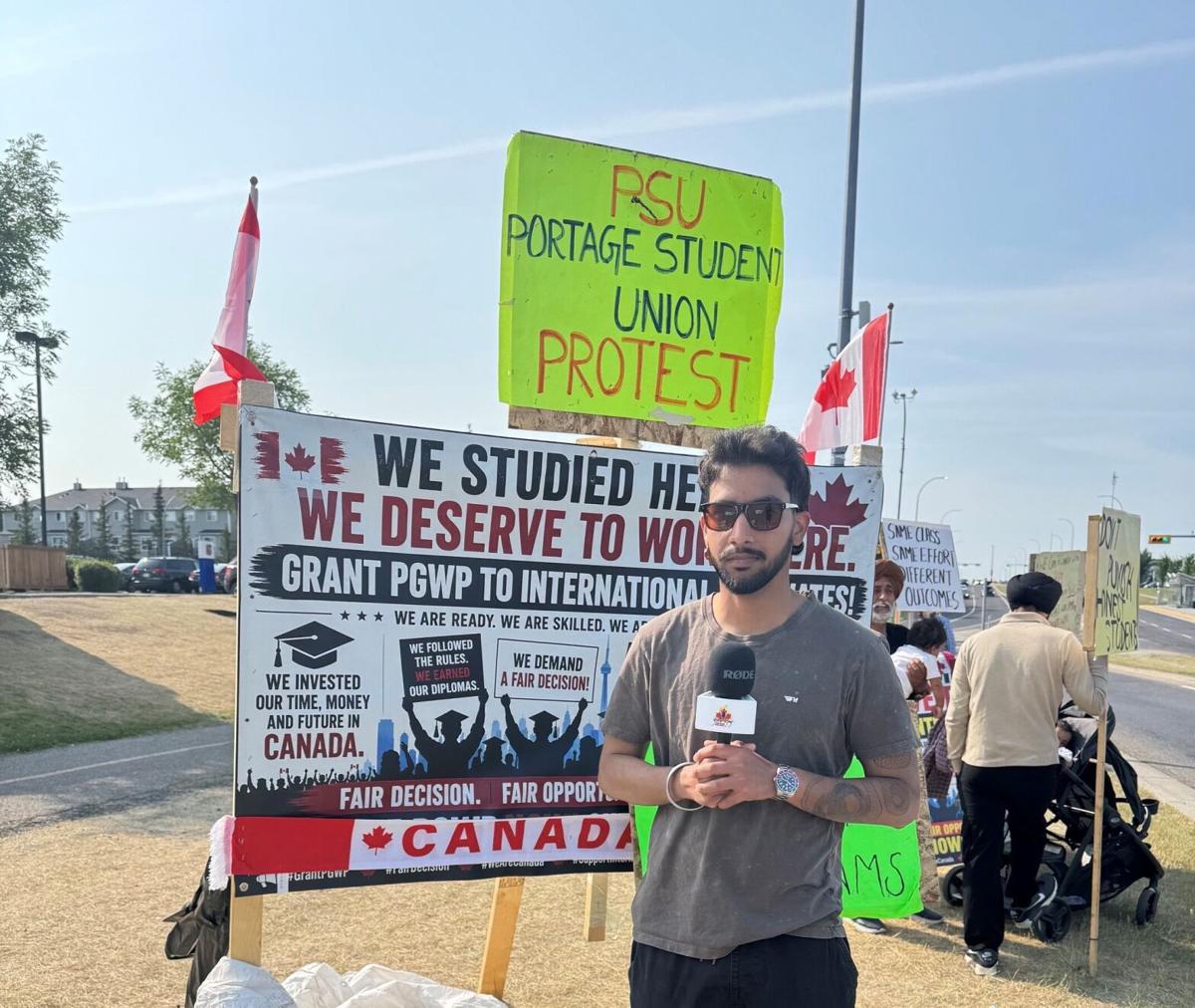
CALGARY — September 2, 2026 — Ten international graduates in Calgary are facing removal from Canada after immigration enforcement officials issued them exclusion orders following a protest over the refusal of their post-graduation work permits, raising concerns among migrant and civil liberties advocates about the right of temporary residents to peacefully demonstrate.
Gurpreet Singh, a 29-year-old international graduate from India, was among students who spent weeks protesting outside the Canadian Institute of Osteopathic Therapy in Calgary after their applications for post-graduation work permits were refused.
The students had graduated from programs offered through a partnership between the private institute and public Portage College. They say they enrolled with the understanding that completing the programs would make them eligible for post-graduation work permits.
Singh came to Canada on a study permit in 2023. His work permit application was refused in July after immigration officials determined that graduates of certain “non-credit” programs were not eligible.
The students responded by organizing a round-the-clock peaceful protest near the school. However, the demonstration took an unexpected turn on Aug. 12 when Canada Border Services Agency officers became involved.
According to CBSA, Calgary police requested an immigration status check on four people at the protest. After two were found to be non-compliant with their immigration status, border officers attended the location and conducted further checks.
The immigration status of 20 people was eventually verified, with 12 identified as potentially inadmissible and asked to attend follow-up interviews. Advocates say 10 students have since received exclusion orders requiring them to leave Canada.
Singh believes the enforcement action has discouraged other international students from continuing the protest, saying many are now afraid that participating could expose them to immigration enforcement.
The incident has prompted more than 250 civil liberties, human rights, labour, faith, migrant, refugee and community organizations to support an open letter calling for an independent investigation.
The letter was sent to Prime Minister Mark Carney, Public Safety Minister Gary Anandasangaree, Immigration Minister Lena Metlege Diab and Alberta Premier Danielle Smith.
The organizations argue that freedom of expression and peaceful assembly are Charter-protected rights and should apply to migrants as well as Canadian citizens and permanent residents. They are calling for the exclusion orders against the 10 students to be withdrawn and for clear rules preventing peaceful protests from becoming a trigger for immigration enforcement.
CBSA defended its actions, saying inland investigations are necessary to identify foreign nationals who may not be complying with Canadian immigration law. The agency said temporary residents are expected to leave Canada when their authorized stay expires and cannot work or study without proper authorization.
At the same time, CBSA acknowledged that peaceful assembly is protected under the Charter and said it is reviewing the concerns raised in the open letter.
The controversy stems from the rejection of post-graduation work permits involving students who completed programs connected to the CIOT-Portage College partnership.
Syed Hussan of the Migrant Rights Network said approximately 1,500 international graduates from the programs were denied work permits after immigration authorities clarified rules concerning non-credit programs.
Advocates argue that many students enrolled believing they would qualify for post-graduation work permits. Portage College has previously said its understanding was that students enrolled in certain non-credit public-private partnership programs before May 15, 2024, would qualify based on the information available at the time and how applications had historically been administered.
Immigration authorities, however, maintain that eligibility requirements were not changed and that information on the government website was updated to clarify existing rules regarding non-credit programs.
Singh said he graduated from an administrative professional certificate program in December 2024 and waited about 18 months for a decision on his post-graduation work permit application.
During that period, he continued working under maintained status. He said he immediately stopped working when his authorization ended following the refusal on July 9.
Singh said his family spent approximately $36,000 on his Canadian education and that the refusal came as a major shock.
He was challenging the work permit decision in Federal Court and considering options to restore his temporary immigration status when CBSA issued the exclusion order.
Singh is now required to report to CBSA every two weeks and confirm his eventual departure from Canada.
Alberta Jobs and Immigration Minister Joseph Schow said temporary residents are expected to return to their home countries once their permits expire and expressed support for police and border authorities enforcing Canadian law.
The incident has nevertheless intensified debate over the treatment of international students caught by immigration eligibility rules that they say were not clearly communicated when they enrolled.
Julia Sande, a lawyer with Amnesty International Canada, warned that immigration enforcement connected to a peaceful demonstration could discourage migrants from exercising their rights.
The dispute now raises two separate but closely connected questions: whether the affected graduates should have qualified for post-graduation work permits based on the rules and information available when they enrolled, and whether immigration enforcement at a peaceful protest could have a chilling effect on temporary residents exercising their Charter-protected rights in Canada.