

STUART, Fla. — Golf legend Tiger Woods has lost his driver’s licence for five years after reaching a last-minute plea agreement in a Florida DUI case stemming from a rollover crash earlier this year.
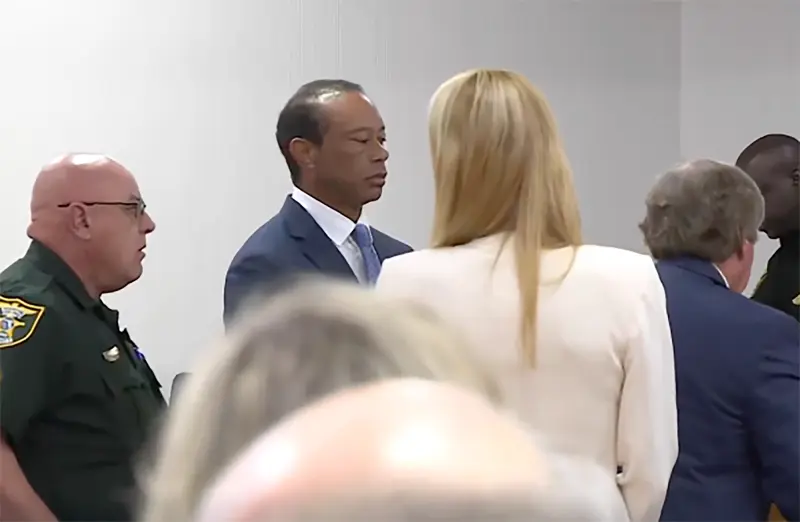
Woods, 50, appeared Wednesday morning at the Martin County Courthouse in Stuart, where a judge accepted an agreement between prosecutors and the defence that reduced the original DUI charge to reckless driving and refusal to submit to a lawful chemical test.
Under the deal, Woods entered no contest pleas to both charges.
The court imposed a $1,000 fine for reckless driving and a $500 fine for refusing the chemical test. Each charge carries a five-year driving suspension, with the two bans running at the same time.
The judge also issued a strong warning to Woods, making it clear that any violation of the driving prohibition could have serious consequences.
Woods was told that if he drives while the suspension is in effect, he could be sent back to jail.
Questions were also raised about whether the restriction would prevent Woods from operating a golf cart. A spokesperson for the Martin County Sheriff’s Office said he could drive a golf cart on private property, although rules may vary when golf carts are operated on public roads or in different jurisdictions.
Woods attended the hearing with his attorney, Douglas Duncan, and his girlfriend, Vanessa Trump.
The plea agreement states that Woods chose not to contest the evidence prosecutors would have presented against him.
After the hearing, the state attorney said the original DUI case would have been difficult to prove because there was insufficient evidence establishing impairment, despite Woods acknowledging that he had taken controlled prescription medication before the crash.
Authorities said Woods refused a urinalysis.
The case began after Woods was involved in a rollover collision near his Jupiter Island home on March 27.
He was initially charged with driving under the influence causing property damage and refusing to submit to a lawful chemical test. He was also cited for reckless driving.
According to the arrest affidavit, responding deputies said Woods showed several possible signs of impairment, including bloodshot and glassy eyes and slow, lethargic movements.
He reportedly failed field sobriety testing and acknowledged taking prescription medication earlier in the day.
Deputies also found two loose pills in his possession that were later identified as hydrocodone, an opioid commonly prescribed for pain management.
Woods denied consuming alcohol or illegal drugs, and breath testing supported his statement that alcohol was not involved.
He told deputies that he had been distracted by his cellphone and radio while driving his Land Rover and did not immediately realize that a vehicle ahead of him had slowed to turn into a driveway.
Woods was arrested at the scene and taken to the Martin County Jail.
He originally pleaded not guilty to the charges.
His court appearance had initially been scheduled for Sept. 8, but a motion filed shortly before the hearing moved the case forward and allowed the plea agreement to be finalized earlier.
The resolution avoids a trial on the more serious DUI allegation while still imposing significant consequences, particularly the five-year loss of driving privileges.
For Woods, the case adds another chapter to a career that has included extraordinary success on the golf course alongside highly publicized personal, medical and legal challenges.
He has undergone numerous surgeries and dealt with significant injuries over the years, including serious damage sustained in previous automobile accidents.
The five-year driving ban is now one of the longest immediate restrictions resulting from his latest legal troubles.
While the plea agreement brings the Florida criminal case to a close, Woods will remain prohibited from driving on public roads for the duration of the suspension and will have to comply with the conditions imposed by the court.