

Canada and the United States appear to be closing in on a new trade agreement, with federal Trade Minister Dominic LeBlanc saying the two countries are “very close” to finalizing a deal before a looming tariff deadline.
LeBlanc made the comments after more than three hours of negotiations in Washington with U.S. Trade Representative Jamieson Greer. He said discussions were lengthy and detailed but continued to move in a positive direction. Canadian officials remained in Washington for further talks as both sides worked to settle the remaining issues.
The stakes are high. Unless an agreement is finalized by midnight Saturday, U.S. President Donald Trump has threatened to impose 50 per cent tariffs on a broad range of Canadian goods.
Canadian officials involved in the talks included chief trade negotiator Janice Charette, Canada’s ambassador to the United States Mark Wiseman and Prime Minister Mark Carney’s chief of staff Marc-André Blanchard.
While the full terms remain confidential, several reports indicate the tentative agreement includes reductions to U.S. sectoral tariffs on Canadian steel and aluminum. The extent of those reductions has not yet been confirmed and is expected to play a major role in how the agreement is received politically in Canada.
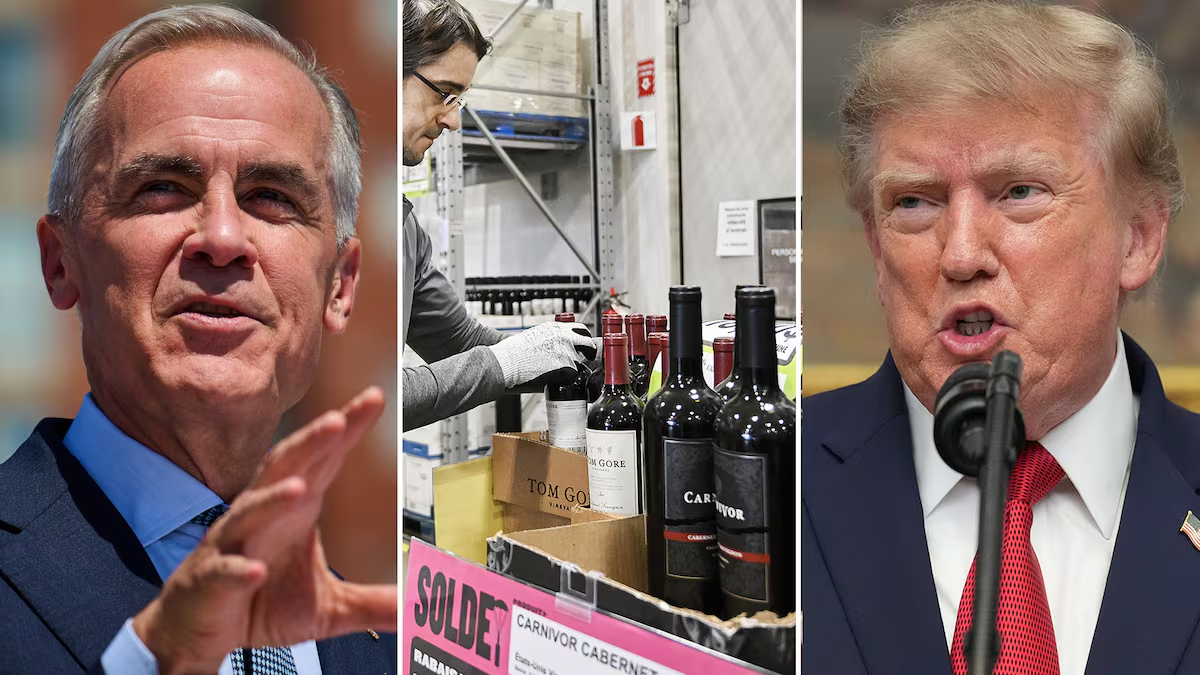
Provincial restrictions on American alcohol have also emerged as a key issue. Several premiers said Carney asked provinces and territories to return U.S. liquor to store shelves as a gesture of good faith during negotiations.
Newfoundland and Labrador Premier Tony Wakeham said provincial leaders agreed to the request, although not every premier has publicly confirmed their position. American alcohol remains unavailable in most provincial liquor systems, with Alberta and Saskatchewan among the exceptions.
Manitoba Premier Wab Kinew has been particularly cautious about the proposed agreement. While acknowledging the Team Canada approach, he urged Canadians to continue buying domestic products even if U.S. alcohol returns to stores.
Kinew said Manitoba could restore some American products relatively quickly, although a full selection could take weeks because of Canadian labelling requirements. He also warned that the province could reconsider its decision if Washington later changes course.
Public resistance to American products could remain an issue even after provincial restrictions are removed. Some consumers have said they have become accustomed to purchasing Canadian alternatives and do not intend to immediately return to U.S. brands.
The negotiations extend well beyond alcohol. Steel, aluminum, automobiles, lumber and agriculture are among the major sectors involved, with dairy emerging as one of Washington’s most important demands.
U.S. Agriculture Secretary Brooke Rollins said the Trump administration remains focused on Canadian dairy rules and wants greater access for American producers. Canada’s supply-management system, which regulates domestic dairy production and controls imports through quotas and tariffs, has long been a source of trade friction between the two countries.
Canadian dairy producers have urged Ottawa not to weaken the system, arguing that supply management provides stability for farmers and rural communities.
Softwood lumber remains another major concern. Canada’s forestry industry employs nearly 200,000 people and continues to face significant U.S. duties. Industry representatives hope the final negotiations will provide relief or at least create a path toward renewed discussions on a long-term lumber agreement.
The Canadian government is also facing political pressure at home. Conservative House Leader Andrew Scheer said his party is cautiously optimistic but warned that an agreement leaving significant tariffs on Canadian steel and aluminum could be difficult for the government to defend.
Several premiers have expressed measured optimism while waiting to see the final terms. Nova Scotia Premier Tim Houston has argued that the dispute demonstrates the need for Canada to diversify its export markets and become less dependent on the United States.
Prime Minister Carney has also been speaking with Mexican President Claudia Sheinbaum about broader North American trade. The two leaders emphasized the importance of renewing the Canada-United States-Mexico Agreement, or CUSMA, to provide greater certainty for workers and businesses across the continent.
Despite encouraging signals from Washington, Canadian officials are stressing that negotiations are not finished. Earlier claims by Trump that the countries already had a deal were described by Canadian provincial sources as premature, with significant details still being negotiated.
For Canada, the final agreement could determine the competitiveness of major industries employing thousands of workers. For the United States, the negotiations involve access to Canadian markets for agricultural products and other exports.
With the tariff deadline rapidly approaching, both governments are now in the final stage of a complex negotiation. LeBlanc’s declaration that the countries are “very close” has increased expectations that an agreement can be reached, but until the final terms are signed, the threat of sweeping 50 per cent tariffs continues to hang over Canada-U.S. trade.