

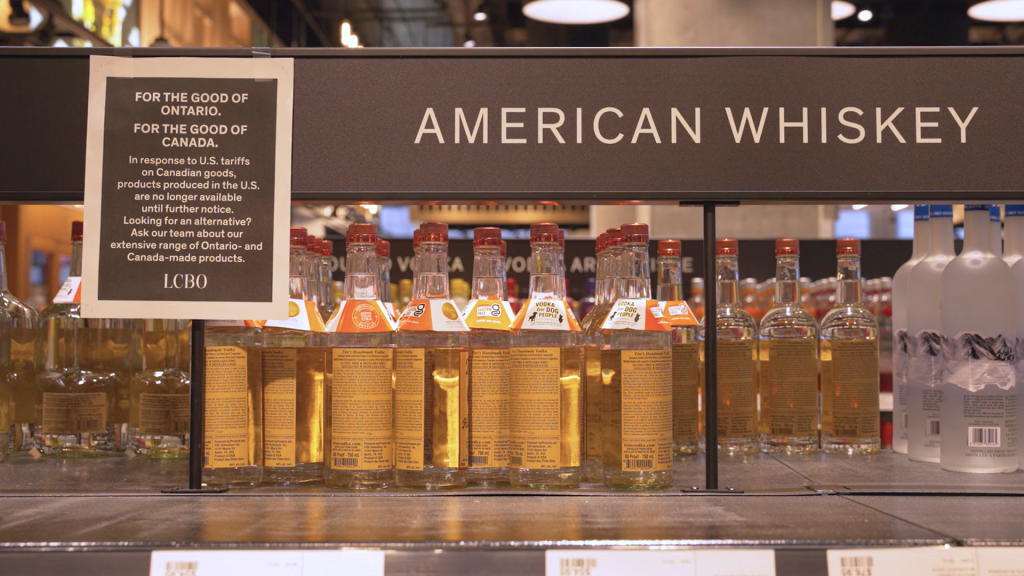
Manitoba Premier Wab Kinew says Prime Minister Mark Carney strongly urged provincial leaders to consider putting American alcohol back on store shelves as Canada races to finalize a trade agreement with the United States and avoid another round of punishing tariffs.
Speaking in Winnipeg, Kinew said Carney briefed the premiers on negotiations aimed at preventing new U.S. tariffs while also addressing existing duties affecting major Canadian industries, including steel, aluminum, forestry and automobiles.
According to Kinew, Carney made it clear that lifting provincial restrictions on U.S. alcohol was an important part of securing an agreement. While he stopped short of saying the prime minister was begging the premiers, Kinew suggested Carney’s appeal came very close to it.
Canadian provinces removed American alcohol from government-controlled liquor stores in 2025 as part of Canada’s response to tariffs imposed by U.S. President Donald Trump. Alberta and Saskatchewan have since ended their restrictions, while most other provinces have maintained them.
Kinew said Manitoba would consider allowing American alcohol to return to Liquor Mart shelves, although he encouraged Canadians to continue supporting domestic producers. He argued that consumers could still choose Canadian-made products even if U.S. brands become available again.
Any return of American liquor to Manitoba stores would not happen immediately. Kinew said the process could take several weeks because products would need appropriate bilingual English and French labelling.
Despite supporting the broader Team Canada approach, Kinew said he would have preferred Canada to take a tougher negotiating position. He argued that Canada should be reluctant to make significant concessions because he believes the country has considerable leverage in its economic relationship with the United States.
The negotiations have entered a critical stage. Canada-U.S. Trade Minister Dominic LeBlanc returned to Washington for further discussions with U.S. Trade Representative Jamieson Greer, accompanied by Canada’s chief negotiator Janice Charette. Canada’s ambassador to the United States, Mark Wiseman, and Prime Minister Carney’s chief of staff, Marc-André Blanchard, also joined the talks.
Trump has temporarily paused a threatened 50 per cent tariff on approximately $28 billion worth of Canadian products while officials work to transform the tentative agreement into a legally finalized deal.
Although full details have not been made public, the negotiations are expected to cover several of the most contentious issues in Canada-U.S. trade, including tariffs on steel, aluminum, lumber and automobiles, American demands for greater access to Canada’s dairy market, Canada’s retaliatory auto tariffs and provincial restrictions on U.S. alcohol.
Reports have suggested that U.S. tariffs on Canadian steel and aluminum could potentially be reduced from 50 per cent to 25 per cent. However, Canadian officials and provincial leaders are still waiting for confirmation of the final tariff levels and other conditions contained in the agreement.
Quebec Premier Christine Fréchette said she had an extensive conversation with Carney and received answers to several questions but wanted to assess the potential economic consequences for Quebec before taking a position. Ontario Premier Doug Ford, whose province is particularly exposed to steel and automotive tariffs, had not publicly commented on the proposed agreement.
Opposition parties are also seeking more information. Bloc Québécois Leader Yves-François Blanchet has called for federal opposition leaders to be consulted, while Conservative Leader Pierre Poilievre said he had not been briefed on either the proposed agreement or the negotiations.
Carney has not yet publicly outlined the full terms of the deal, although he has said the agreement would strengthen Canada’s existing trade advantages with the United States.
Trump, meanwhile, described the proposed agreement as beneficial to both countries and indicated that some tariffs on Canadian steel and aluminum could be lowered.
The stakes remain high. Trump had threatened a new 50 per cent tariff on a broad range of Canadian products in response to Canada’s restrictions on U.S. alcohol, automotive trade measures and limits on tariff-free access for American dairy products.
The threatened duties are especially significant because they could apply even to Canadian products that comply with the Canada-United States-Mexico Agreement, or CUSMA. Goods potentially affected range from hockey sticks and honey to concrete and plywood.
With the tariff deadline approaching, the question of whether American liquor returns to provincial shelves has unexpectedly become part of a much larger negotiation involving billions of dollars in cross-border trade and the future of some of Canada’s most important industries.