

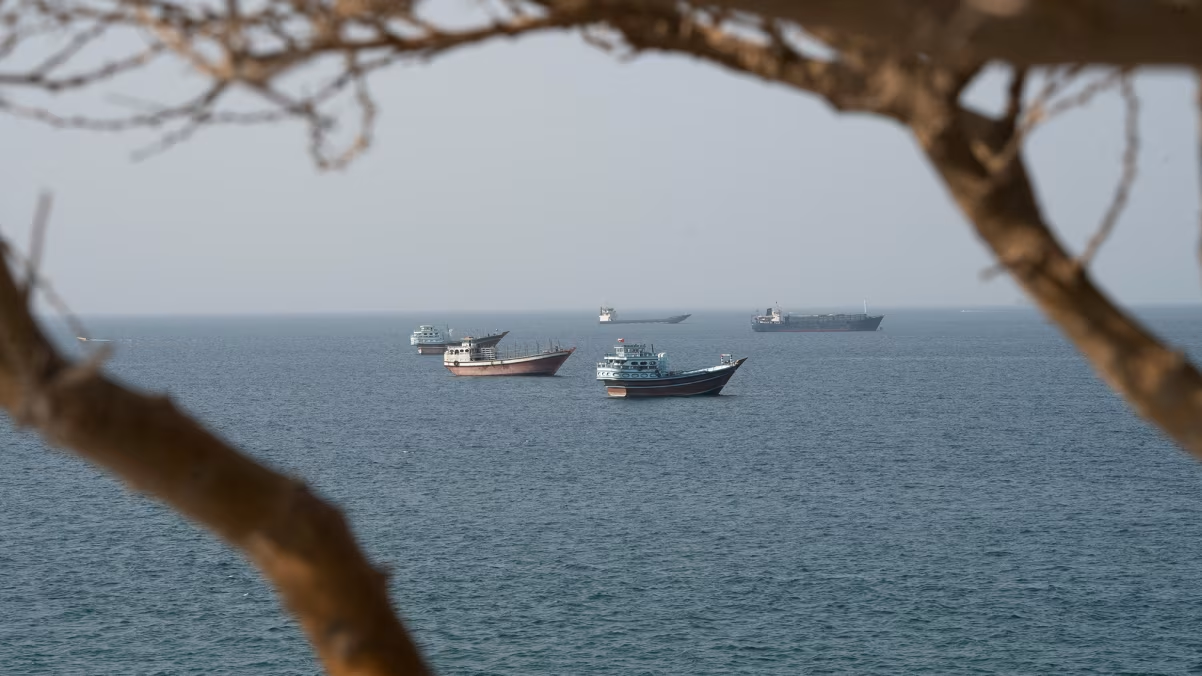
WASHINGTON — Iran appears to be losing some of its ability to control shipping through the strategically vital Strait of Hormuz as growing numbers of vessels use a route along Oman under the protection of U.S. naval forces.
The waterway has emerged as one of the most important fronts in the continuing Iran war because of its crucial role in global energy supplies. Both Tehran and Washington have repeatedly claimed varying degrees of control over the strait, creating considerable uncertainty over the actual situation.
Recent shipping data, however, suggests that Iran’s influence over vessel movements has weakened compared with earlier in the conflict.
According to shipping analytics company Kpler, more than 80 per cent of vessel transits through the Strait of Hormuz during the past two weeks have used the Omani route, a United Nations-authorized shipping channel opposed by Iran.
That represents a dramatic change from approximately one month earlier, when Kpler recorded virtually no shipping traffic using the route.
Iran has claimed authority over the strait and has attacked numerous vessels attempting to travel through waters near Oman’s northern coastline. Despite those risks, an increasing number of ships have chosen the Omani route while relying on the presence of U.S. naval forces for protection.
Homayoun Falakshahi, Kpler’s head of crude oil analysis, said the changing traffic patterns increasingly suggest Iran has at least partially lost control of the waterway.
The shift also has financial consequences for Tehran. Earlier in the conflict, Iran had been collecting tolls from some vessels passing through the strait. With ships increasingly avoiding Iran’s preferred route, Tehran appears to have lost much of its ability to collect those payments.
The expiration this week of a memorandum of understanding between the United States and Iran theoretically allows Tehran to resume charging tolls. Shipping analysts, however, say there is little evidence that Iran has been able to enforce those demands against most vessels.
Regional oil exporters are also adopting new methods to move crude through the increasingly dangerous area.
Kuwait, Saudi Arabia and the United Arab Emirates have reportedly chartered Very Large Crude Carriers, among the world’s largest oil tankers, to transport petroleum through the Strait of Hormuz before transferring the crude to customers’ vessels in the Gulf of Oman outside the most dangerous area.
Some vessels have reportedly switched off their electronic transponders for extended periods to reduce the risk of detection and attack by Iran.
This practice, often described as “dark” shipping, makes it considerably more difficult for commercial tracking organizations to determine exactly how much oil is moving through the region. Satellites can detect some vessels, but conventional transponder-based monitoring may miss substantial amounts of traffic.
The United States, which has deployed significant military resources in the region, says its surveillance provides a more complete picture.
U.S. Energy Secretary Chris Wright said last week that approximately 15 million barrels of oil per day were either passing through the Strait of Hormuz or being transported through alternative routes during a recent seven-day period.
That would represent a substantial recovery toward the approximately 20 million barrels per day that moved through the region before the war.
President Donald Trump has gone further, declaring that the United States now has “total control” of the Strait of Hormuz.
Available evidence, however, suggests the situation is considerably more complicated.
Iran continues to possess the ability to attack shipping, and oil movements remain below pre-war levels. Those factors indicate that Washington has not achieved complete control of the waterway.
At the same time, Iran also appears unable to dictate shipping routes or prevent a substantial number of vessels from moving through the strait under American protection.
Energy analyst Dan Pickering said Iran’s objective may be less about exercising complete physical control and more about maintaining enough military deterrence to influence shipping decisions.
If U.S. estimates of recovering oil traffic are accurate, however, Iran’s ability to deter shipping has weakened substantially compared with conditions earlier in the conflict.
The situation is further complicated by diplomatic efforts involving Oman and Iran.
The two countries are reportedly discussing possible arrangements aimed at restoring freedom of navigation through the Strait of Hormuz without direct U.S. involvement. It remains uncertain whether those negotiations will produce an agreement or how they might affect shipping patterns and the broader military struggle over the waterway.
The Strait of Hormuz remains strategically critical because a significant share of the world’s petroleum supplies normally passes through the narrow passage connecting the Persian Gulf with the Gulf of Oman and international markets.
Any prolonged disruption can affect global oil supplies, gasoline prices, shipping costs and inflation far beyond the Middle East.
For now, neither Iran nor the United States appears to exercise absolute control over the strait. But the growing use of the Omani shipping corridor and the recovery in oil movements indicate that Iran’s ability to dictate conditions in the waterway has weakened.
The changing balance could prove important not only for the military conflict but also for global energy markets. If more commercial vessels conclude that they can safely transit the strait despite Iranian threats, oil flows could continue recovering and reduce some of the economic pressure created by the war.
At the same time, Iran’s continuing ability to threaten vessels means the Strait of Hormuz remains a dangerous and unpredictable flashpoint, with military developments and diplomatic negotiations capable of quickly changing the situation.