

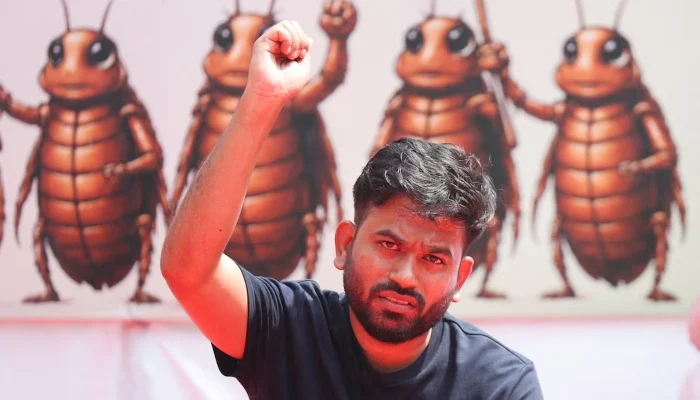
New Delhi, July 24: A single social media post has transformed Abhijeet Dipke, a 30-year-old political communications strategist, into one of the most recognizable faces of India’s largest youth-led protest movement in more than a decade.
Dipke has become the public face of the Cockroach Janta Party (CJP), a movement that has mobilized tens of thousands of students and young people demanding education reforms, greater government accountability and the resignation of Education Minister Dharmendra Pradhan following allegations of examination paper leaks.
The movement traces its origins to a brief post Dipke published on the social media platform X on May 16, asking, “What if all cockroaches come together?”
The remark was a satirical response to comments attributed to Supreme Court Justice Surya Kant, whose earlier remarks comparing unemployed youth to “cockroaches” generated widespread public debate. Justice Kant later clarified that his comments had been misconstrued.
Dipke’s post quickly went viral, inspiring the creation of the satirical Cockroach Janta Party, which soon evolved into a nationwide platform expressing frustration over unemployment, examination irregularities and opportunities for young people.
The movement gained significant momentum after alleged leaks involving India’s national medical entrance examination, which affected nearly two million candidates and intensified public concern about the integrity of competitive examinations.
Over the past week, tens of thousands of demonstrators have gathered in New Delhi, while solidarity protests have also been reported in several other cities, including Mumbai.
Dipke, who had been pursuing a master’s degree in public relations in Boston, Massachusetts, returned to India in early June to join the growing demonstrations.
Since then, he has become a constant presence at the protest site near Jantar Mantar, addressing crowds, speaking with the media and repeatedly urging demonstrators to maintain peaceful protests while continuing to press for reform.
Born in Aurangabad, Maharashtra, into a Dalit family, Dipke has frequently spoken about how his upbringing influenced his views on social justice and equal opportunity.
His father, he has said, was raised in extreme poverty, while his grandfather worked as a farmer.
Dipke has also publicly acknowledged the influence of Dr. B.R. Ambedkar, the principal architect of India’s Constitution and a leading advocate for the rights of historically disadvantaged communities.
When he arrived in Delhi to join the protests, he carried a copy of Ambedkar’s autobiography as a symbolic gesture.
Before launching the CJP movement, Dipke worked with the social media team of the Aam Aadmi Party (AAP) in 2020, where he developed experience using satire, memes and digital communication in political campaigns.
He later moved to the United States to pursue graduate studies but continued following Indian politics closely.
The movement’s rapid growth has been driven largely through social media.
Supporters and content creators developed a satirical CJP website and online campaign, helping the movement attract millions of followers within days and transforming an internet meme into one of India’s most significant youth mobilizations in recent years.
Despite receiving criticism and personal threats, including an incident in which blue ink was thrown at him during a public address, Dipke has remained at the protest site.
Following that incident, he responded on social media by writing, “Blue is my colour,” a reference widely interpreted as a tribute to the Ambedkarite movement.
Speaking to supporters this week, Dipke reaffirmed the movement’s determination, declaring that protesters would continue their campaign until their demands for accountability and education reforms are addressed.
While the Cockroach Janta Party began as a satirical online campaign, it has since evolved into a broader movement highlighting concerns over examination integrity, youth employment and governance. Whether it develops into a lasting political force remains uncertain, but its rapid rise has already made it one of the most significant youth-led movements in India in recent years.