

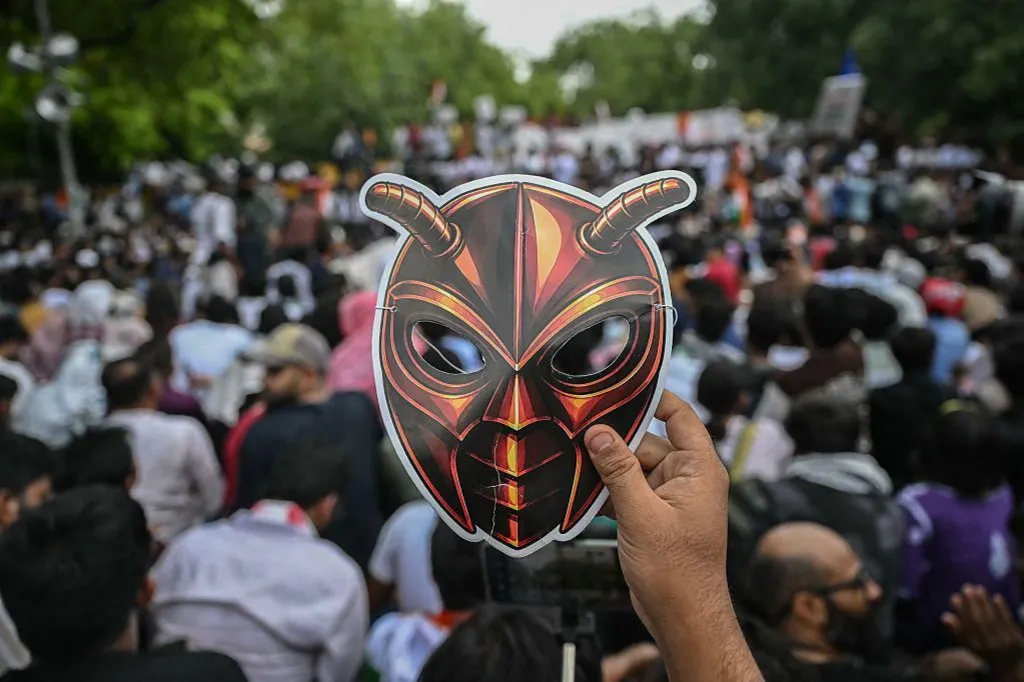
New Delhi, July 24: What began as outrage over repeated examination paper leaks has rapidly evolved into one of India’s largest student-led protest movements in years, with analysts suggesting it now reflects broader concerns about governance, employment opportunities and public accountability.
The Cockroach Janta Party (CJP), a youth-led movement launched in response to alleged irregularities in public examinations, has mobilized tens of thousands of students across India in recent weeks.
The movement is demanding comprehensive reforms to the country’s examination system and the resignation of Education Minister Dharmendra Pradhan, who has rejected calls to step down and has accused political opponents of attempting to exploit student concerns.
The protests intensified this week when large crowds attempted to march toward Parliament in New Delhi, prompting police to use tear gas and baton charges after clashes broke out. Demonstrations have continued in several locations since then.
At the centre of the campaign is environmental activist Sonam Wangchuk, who recently ended a 26-day hunger strike undertaken in support of the movement. Student leaders have indicated that demonstrations will continue despite the conclusion of the fast.
Unlike several major protest movements witnessed during Prime Minister Narendra Modi’s tenure, political analysts say the CJP movement is distinguished by its broad social appeal.
Rather than focusing on ideology or the interests of a particular community, the protests centre on concerns that repeated examination paper leaks and recruitment controversies have undermined confidence in a system that millions of young Indians view as their primary pathway to education, employment and upward social mobility.
Yamini Aiyar, a Senior Visiting Fellow at Brown University, told the BBC that the issue cuts across caste, class and gender, attracting participants from a wide range of backgrounds.
Similarly, Rahul Verma, a fellow at the Centre for Policy Research, argued that the movement challenges the government’s administrative performance rather than its ideology.
According to Verma, many of the protesters are not traditional political opponents of the ruling Bharatiya Janata Party (BJP) but are young Indians and their families seeking fair opportunities through competitive examinations.
Observers also point to the movement’s rapid growth on social media.
Joyojeet Pal, a professor at the University of Michigan, said digital platforms have enabled widespread frustration to spread quickly, helping transform online conversations into large-scale street demonstrations.
Experts say the combination of digital activism and public demonstrations has created one of the most significant youth mobilizations since India’s anti-corruption movement in 2011.
Following the protests, senior BJP leaders defended the government’s record while accusing opposition parties of politicizing student grievances.
Prime Minister Narendra Modi addressed the issue publicly for the first time on Thursday, stating that the welfare and future of young people remain a government priority.
He announced plans for fast-track courts to prosecute those responsible for examination paper leaks and pledged that individuals attempting to undermine students’ futures would face strict punishment.
Political scientists remain divided over the movement’s long-term significance.
Some believe it could become a lasting force demanding greater accountability in governance, while others argue it may gradually lose momentum, as has happened with previous protest movements.
Economist Surajit Mazumdar of Jawaharlal Nehru University said the demonstrations reflect wider dissatisfaction among young Indians that extends beyond examination irregularities to concerns about employment prospects, economic opportunities and confidence in public institutions.
Whether the CJP movement develops into a broader political force or remains focused on education reform remains uncertain.
However, analysts broadly agree that the protests have highlighted growing demands among India’s youth for transparent governance, credible public institutions and equal opportunities in education and employment.
The protests continue, and discussions between government officials and movement representatives are expected to shape the next phase of one of India’s most significant youth-led campaigns in recent years.