

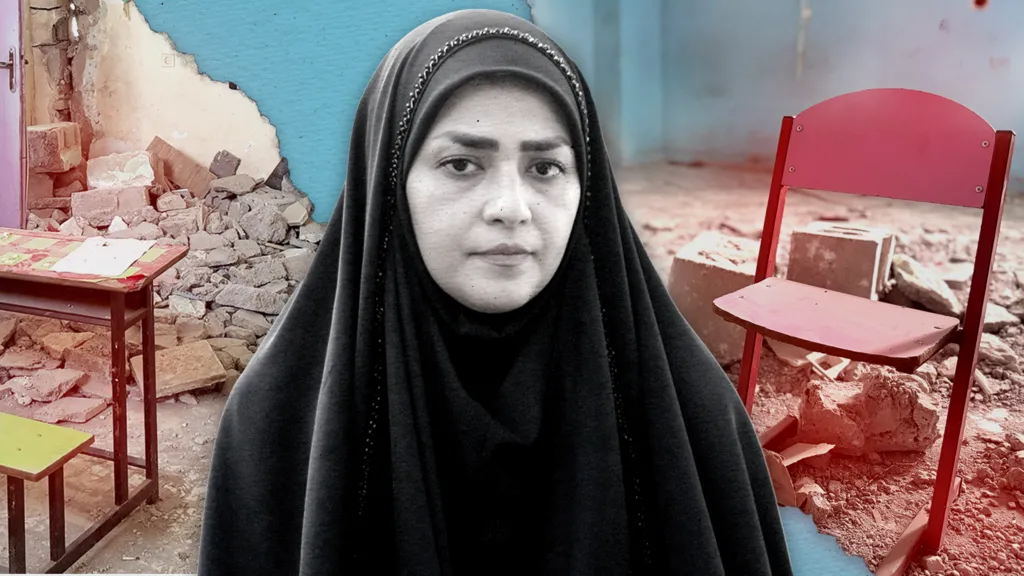
Minab, Iran, July 23: A BBC investigation has documented the devastating aftermath of a wartime strike on a primary school in the southern Iranian city of Minab, where local authorities say 156 people, including 120 children, were killed during the opening hours of the U.S.-Israeli conflict with Iran earlier this year.
The strike occurred on February 28, 2026, at Shajareh Tayyebeh Primary School, where students and teachers had gathered during the holy month of Ramadan before classes began.
According to the Minab prosecutor’s office, those killed included children, teachers, school staff, a pregnant woman and her unborn child.
The BBC interviewed survivors, rescue workers and grieving families during a visit to the heavily damaged school, where portions of the two-storey building remain standing while much of the structure has collapsed into rubble.
Teacher Amaineh Nademi, who taught first-grade students at the school, recalled hearing explosions before the building was struck.
She said the school had begun dismissing students after reports of attacks elsewhere in Iran, and only a handful of children remained in her classroom when the explosion occurred.
Nademi described carrying injured students through thick smoke before escaping the collapsing building.
Rescue worker Reza Besharati of the Iranian Red Crescent Society said emergency crews arrived within minutes but faced scenes of widespread devastation.
He told the BBC that many victims could only be identified by their clothing or personal belongings because of the severity of the destruction.
Parents interviewed by the BBC described rushing to the school after hearing the explosion and searching desperately for their children.
One mother, Masoumeh Mehran Shekhabadi, said her nine-year-old daughter Setayesh was eventually identified by the socks she had been wearing.
The BBC reported that independent experts who reviewed satellite imagery and video evidence concluded that the nearby Islamic Revolutionary Guard Corps (IRGC) compound had also been struck during the attack.
The report states that experts believe the strike was likely carried out by U.S. forces, although the United States has not publicly accepted responsibility.
According to the BBC, several U.S. media organizations, citing unnamed sources familiar with an internal military investigation, reported that preliminary findings suggested outdated intelligence may have mistakenly identified the school as part of a military facility.
The U.S. Department of Defense has acknowledged that an investigation is underway but has not released its findings.
Military officials have repeatedly stated that U.S. forces do not intentionally target civilians.
Iranian officials reject suggestions that the school was located within an active military installation and have cited the attack as evidence that civilians suffered heavily during the conflict.
The tragedy has become a prominent symbol in Iran, where authorities have repeatedly referenced the incident in public statements and diplomatic forums.
The BBC noted that the strike has also influenced public debate within Iran, with some government critics acknowledging that the deaths of so many children underscored the devastating human cost of the conflict.
As investigations continue, the circumstances surrounding the strike remain disputed.
The reported casualty figures and accounts cited in the BBC investigation are based on information provided by Iranian authorities and eyewitnesses, while the findings of the U.S. military investigation have not yet been made public.
The incident stands as one of the deadliest reported civilian tragedies of the 2026 Iran conflict and continues to raise difficult questions about intelligence, targeting decisions and the protection of civilians during armed conflict.