

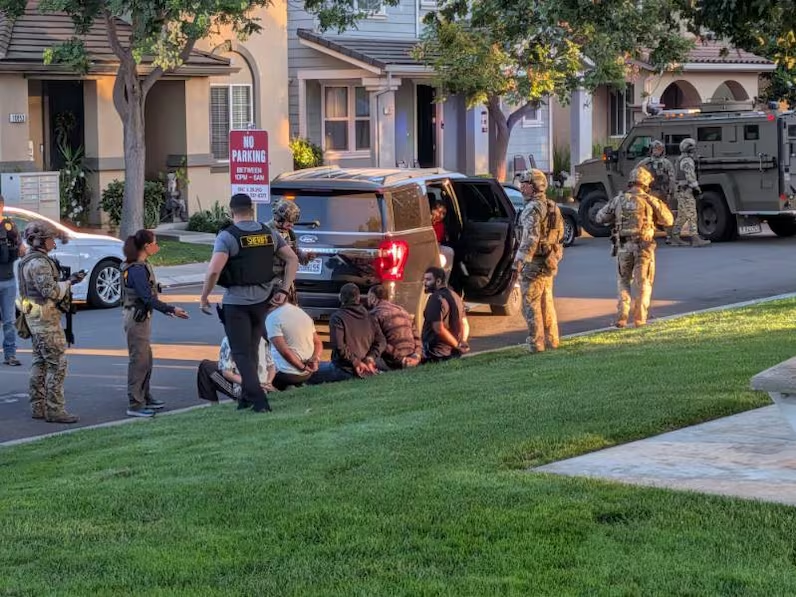
VANCOUVER: Canadian and American law enforcement agencies have launched a major cross-border operation targeting alleged transnational organized crime networks linked to India, resulting in sweeping criminal charges involving extortion, drug trafficking, murder, and other serious offences.
The joint investigation, known as Operation Hard Ball, was announced by the U.S. Federal Bureau of Investigation (FBI) and the Royal Canadian Mounted Police (RCMP). Authorities have charged 37 individuals connected to three separate criminal organizations, including the alleged Lawrence Bishnoi Organized Crime Group, another network led by imprisoned gangster Jaggu Bhagwanpuria, and a drug trafficking organization allegedly headed by British Columbia resident Ravinder Singh Dhanda.
At a joint announcement, FBI and RCMP officials described the operation as a significant blow against criminal organizations accused of terrorizing communities in Canada and the United States through violence, extortion, drug trafficking, and other organized criminal activities.
According to U.S. court documents, Lawrence Bishnoi, who has been incarcerated in India since 2015, allegedly continued directing an international criminal enterprise from prison using smuggled communication devices. Prosecutors allege that the organization has orchestrated murders, extortion schemes, kidnappings, human smuggling, drug trafficking, shootings, and other violent crimes across several countries.
The indictment further alleges that the group recruited young people, particularly from Punjab, India, promising money, status, and protection before sending some recruits abroad on student and work visas to assist with criminal operations in countries including Canada and the United States.
Canadian court proceedings and immigration hearings over the past year have revealed similar allegations involving individuals who entered Canada on temporary visas before allegedly participating in shootings, arson attacks, extortion, vehicle theft, insurance fraud, and other criminal activities.
Investigators allege that gang members were paid relatively small amounts to carry out violent attacks. In one British Columbia case, a convicted gunman admitted receiving payment after firing multiple shots at the Vancouver Island home of Punjabi singer AP Dhillon. Other accused individuals allegedly carried out shootings and arson attacks targeting businesses and residences connected to extortion demands.
The U.S. indictment also names Satinderjeet Singh, commonly known as Goldy Brar, as one of Bishnoi’s closest associates and alleges that he supervised the organization’s North American operations during the period covered by the investigation. Brar remains wanted by U.S. authorities, who have announced a reward of up to US$50,000 for information leading to his arrest.
Prosecutors allege Brar personally threatened several victims in Canada, demanding large extortion payments while warning of deadly consequences for those who refused to comply.
The indictment also alleges that Bishnoi and Brar directed the 2023 assassination of Sikh activist Hardeep Singh Nijjar outside a Surrey, British Columbia gurdwara. According to the court documents, Bishnoi allegedly supplied one of the conspirators with Nijjar’s photograph and location details before the killing.
Four Indian nationals previously charged with first-degree murder and conspiracy in Nijjar’s death remain before the courts, where the allegations have not yet been tested at trial. The U.S. indictment does not allege any involvement by the Government of India in the killing. India has consistently denied any role in Nijjar’s assassination.
Operation Hard Ball also highlights the broader extortion crisis affecting businesses, particularly within South Asian communities in British Columbia, Alberta, and Ontario. Canadian investigators have linked numerous shootings, arson attacks, and threats to organized extortion networks operating across provincial borders.
Police say the criminal organizations frequently move firearms, suspects, and stolen vehicles between provinces, making investigations particularly challenging. Authorities also allege that stolen vehicles have been used to commit crimes before being deliberately burned and falsely reported as stolen for insurance purposes.
Earlier this year, Canadian immigration authorities deported several foreign nationals alleged to have connections with organized crime after investigations linked them to extortion, shootings, fraud, and other violent offences.
Separately, three men arrested in British Columbia this week are facing extradition proceedings to the United States following allegations that they participated in an international drug trafficking organization accused of smuggling large quantities of cocaine and methamphetamine across North America. U.S. prosecutors allege the network operated in Canada, the United States, and Mexico and, if convicted, some of the accused could face life imprisonment.
Authorities in both countries say the investigation remains active and additional enforcement actions are expected as they continue dismantling transnational organized crime networks operating across North America.
The allegations contained in the U.S. indictments and Canadian court proceedings remain allegations. The accused are presumed innocent unless proven guilty in court.