

CALGARY, July 2, 2026 — The Alberta government has formally unveiled plans for a major new crude oil pipeline to British Columbia’s southern coast, marking a significant step in Canada’s efforts to expand energy exports and strengthen access to international markets. The proposal follows a new agreement between the federal government and British Columbia aimed at advancing nationally significant infrastructure while addressing environmental protection and Indigenous participation.
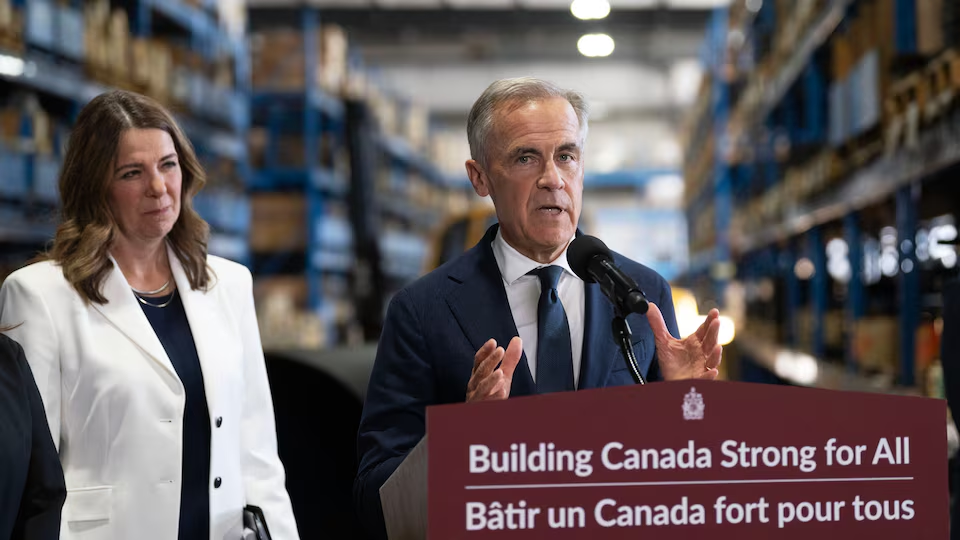
Prime Minister Mark Carney and Alberta Premier Danielle Smith announced that Alberta has submitted its proposed pipeline route to the federal Major Projects Office for review. The project would transport more than one million barrels of bitumen per day from Bruderheim, northeast of Edmonton, to a marine export terminal in Delta, British Columbia, following much of the existing Trans Mountain Corporation pipeline corridor. From there, oil would be shipped primarily to growing Asian markets.
Premier Smith described the project as a transformational economic opportunity that could generate billions of dollars in long-term revenues for both provincial and federal governments while creating new economic opportunities for Indigenous communities that choose to participate. She emphasized that the proposed pipeline represents a nation-building investment capable of strengthening Canada’s energy sector and long-term economic prosperity.
Estimated to cost between $35.2 billion and $43.7 billion, the project is being advanced through a partnership involving the Alberta government, Trans Mountain Corporation and Pembina Pipeline Corporation. Alberta has already invested more than $18 million in preliminary planning and aims to secure designation as a project of national interest by October 1. While the final ownership structure is still being negotiated, Pembina has indicated it expects to hold an initial 10 per cent ownership stake that could increase once the pipeline becomes operational.
The proposed route would pass through the traditional territories of approximately 125 Indigenous communities. Federal and provincial leaders said Indigenous consultation will continue throughout the planning process, with opportunities being explored for Indigenous equity ownership and long-term participation in the project.
The announcement follows a broader agreement between Ottawa and the Government of British Columbia led by Premier David Eby. Under the agreement, the federal government has committed to maintaining the existing oil tanker ban along British Columbia’s northern coast while supporting the southern pipeline proposal. Ottawa has also pledged to assume financial responsibility for certain environmental risks, including potential spill-related costs, if the project proceeds.
As part of the agreement, British Columbia would receive annual financial compensation for hosting the pipeline, while the federal government has committed approximately $10 billion toward expanding infrastructure at Roberts Bank Terminal in Delta. The proposed upgrades are expected to increase Canada’s trade capacity significantly and strengthen the country’s export competitiveness.
Premier Eby reiterated that British Columbia is not endorsing the pipeline but acknowledged the province’s constitutional responsibilities. He confirmed that the provincial government will participate in routing and permitting discussions in good faith and indicated it would not seek to block the project through court challenges, provided the commitments made by Ottawa are honoured.
The proposal has generated sharply differing political reactions. Federal Conservative Leader Pierre Poilievre criticized the continuation of the northern oil tanker ban, arguing that Canada should remove barriers preventing greater access to global energy markets and allow private industry to build the necessary infrastructure with minimal government intervention.
Within the New Democratic Party, opinions also differed. Alberta NDP Leader Naheed Nenshi welcomed progress on the southern pipeline route and the associated carbon capture initiative, describing both as important to securing the long-term future of Alberta’s energy sector. Federal NDP Leader Avi Lewis, however, criticized the proposal, arguing that taxpayers could ultimately bear much of the financial and environmental risk while private companies benefit from the project’s profits.
Environmental organizations have also voiced concerns over the project’s potential costs and environmental impact, questioning the structure of the proposed public-private partnership and warning against placing additional financial burdens on Canadian taxpayers.
If approved, the pipeline would become one of the largest energy infrastructure projects in Canadian history, significantly expanding export capacity while continuing to fuel national debate over economic development, environmental protection, Indigenous participation and Canada’s long-term energy strategy.
Source: Adapted from CTV News and The Canadian Press.