

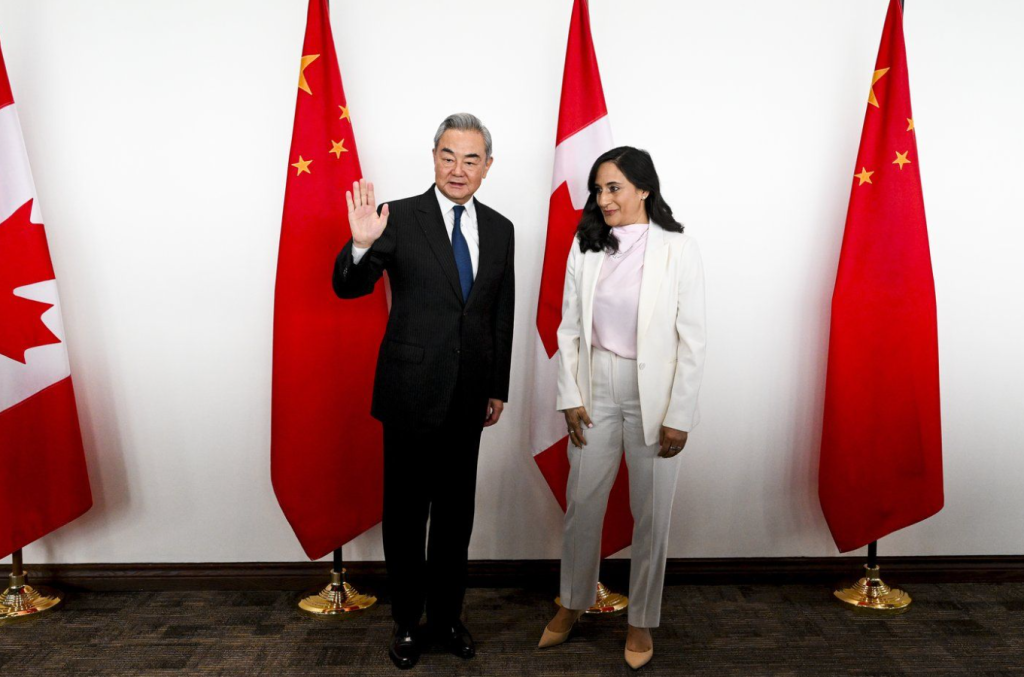
Canada and China are moving toward a cautious diplomatic reset as Foreign Affairs Minister Anita Anand welcomed Chinese Foreign Minister Wang Yi to Ottawa on Friday, marking the first visit by a Chinese foreign minister to Canada in a decade.
The high-level meeting comes at a delicate moment in Canada-China relations, just days after a Canadian warship passed through the Taiwan Strait despite warnings from Beijing that such actions could harm the improving bilateral relationship.
Anand said Canada remains committed to deepening engagement with China while protecting Canadian economic interests, national security, and democratic values.
Speaking alongside Wang and his delegation at Global Affairs Canada headquarters in Ottawa, Anand said Canada aims to increase exports to China by 50 per cent by 2030 as part of a broader strategy to grow the economy and diversify international trade relationships.
She said both countries have set out a clear and ambitious vision for a “recalibrated relationship” following Prime Minister Mark Carney’s visit to Beijing earlier this year.
According to Anand, the renewed relationship includes stronger engagement and cooperation on trade, investment, energy, finance, public security, safety, and people-to-people ties.
“At the same time, each of our countries must address critical issues and priorities to ensure the safety and security of our peoples,” Anand said.
Wang responded by saying Canada could not only meet but potentially exceed its target of increasing exports to China if the bilateral relationship remains stable and constructive.
He said China is on track to become the world’s largest market and remains open to Canadian goods, investment, and cooperation.
The meeting follows Carney’s January visit to China, where he met with Chinese President Xi Jinping. After that visit, Canada and China reached a preliminary trade understanding under which Beijing agreed to lower or remove some tariffs on Canadian agricultural products, while Canada agreed to reduce tariffs on some Chinese electric vehicles.
Carney said this week that the Beijing meetings were necessary because diplomatic relations had broken down, trade had been undermined by tariff disputes, and the overall relationship was “in need of a reset.”
Canada-China relations deteriorated sharply after Canada detained Huawei executive Meng Wanzhou in 2018 at the request of the United States. China later detained Canadians Michael Spavor and Michael Kovrig, creating one of the most serious diplomatic crises between the two countries in modern history.
Wang’s visit is expected to include discussions on the updated Canada-China Strategic Partnership, trade, investment, global security, and regional tensions.
One of the most sensitive issues likely to shadow the visit is Taiwan.
China claims Taiwan as part of its territory and has strongly objected to foreign military transits through the Taiwan Strait, as well as official visits by foreign lawmakers to Taipei.
Beijing’s envoy recently warned that Canadian parliamentary visits to Taiwan and Canadian naval activity in the Taiwan Strait could damage the warming relationship.
Despite that warning, Canadian defence officials confirmed that HMCS Charlottetown conducted a routine transit through the Taiwan Strait between May 22 and May 23.
Conservative MP Michael Chong also met Taiwan’s President Lai Ching-te earlier this month, saying the visit was intended to assert Canada’s sovereignty in the face of pressure from Beijing.
The visit by Wang Yi therefore represents both an opportunity and a test for Canada’s foreign policy.
Ottawa is seeking stronger trade access and more stable diplomatic ties with China while also maintaining its positions on security, sovereignty, human rights, and international rules-based navigation.
For Canada, the challenge will be finding a practical balance between economic opportunity and national values. For China, the visit offers a chance to rebuild influence and trust with a G7 country after years of strained relations.
As Wang meets Anand and Prime Minister Carney, the discussions will be closely watched by business leaders, diplomats, security experts, and communities across Canada with deep personal, economic, and cultural connections to China.
The outcome of this visit may help determine whether the two countries can move beyond years of tension and establish a more stable, realistic, and carefully managed relationship in the years ahead.