

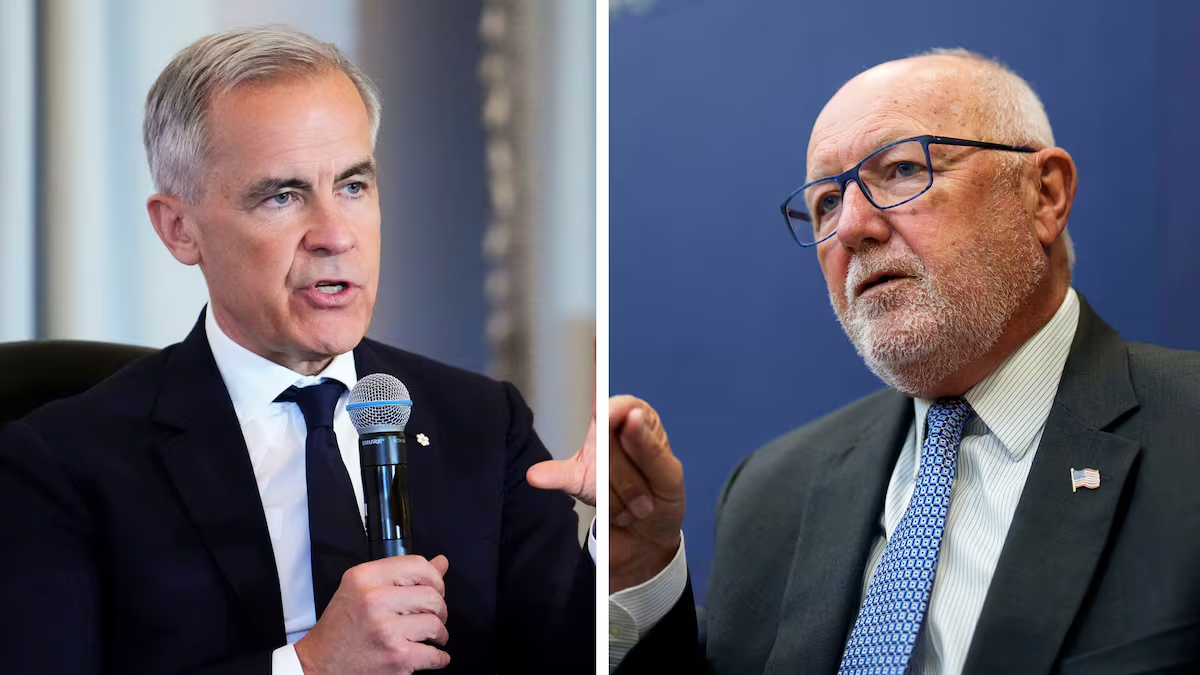
Prime Minister Mark Carney stirred political debate on both sides of the border Thursday after telling influential American business leaders that “a Canada strong will help make America great again,” a remark that quickly drew praise from the U.S. ambassador while triggering criticism from opposition Conservatives back home.
Speaking before the prestigious Economic Club of New York, Carney used U.S. President Donald Trump’s signature “Make America Great Again” slogan to frame his broader message that a stronger, more economically independent Canada ultimately benefits the United States as well.
The prime minister’s speech focused heavily on economic diversification, international partnerships, energy security, and the deeply integrated economic relationship between Canada and the United States amid continuing trade tensions and uncertainty surrounding the future of the Canada-U.S.-Mexico Agreement.
“We’re focused on what we can control,” Carney told the audience. “That means weaving a dense web of international partnerships abroad. That’s making us a much stronger, more resilient, more independent country.”
At the same time, Carney stressed that Canada’s efforts to become more self-reliant should not be interpreted as turning away from the United States.
“Above all, we’re focused on things that are good for Canada,” he said. “This is good for all Canadians, but it’s also good for the United States. Because a stronger Canada is a better ally.”
The prime minister emphasized the enormous economic ties between the two countries, noting that Canada remains America’s largest customer and purchases more U.S. goods than China, Japan, and Germany combined.
He also pointed to the highly integrated North American supply chain, highlighting how Canadian exports contribute directly to American manufacturing, construction, aerospace production, and industrial growth.
“Those common interests run through our supply chains,” Carney said, adding that Canadian energy exports — including natural gas, electricity, and crude oil — continue playing a critical role in supporting American energy needs.
The line that generated the strongest reaction came when Carney declared that “Canada strong will help make America great again,” a phrase that quickly circulated widely online and caught the attention of Pete Hoekstra.
In a post on X, Hoekstra praised the remark and said many Americans would support such a message.
“PM Carney said something worth repeating today,” Hoekstra wrote. “A Canada strong will help make America great again. I think a lot of Americans can get behind that kind of positive message.”
Carney’s appearance in New York comes at a delicate moment in Canada-U.S. relations as both countries continue navigating trade disputes, tariffs, and upcoming negotiations tied to the future review of the Canada-United States-Mexico Agreement.
Without providing specific details, Carney revealed that his government has already presented “specific, practical proposals” to the U.S. administration aimed at improving the current relationship and easing ongoing tensions.
During a post-speech discussion, Carney described Canada’s energy sector as part of the solution to global and North American energy security challenges and suggested North America’s auto, steel, and aluminum sectors should evolve into a more integrated economic “fortress.”
The prime minister also addressed defence and foreign policy issues, including Canada’s relationship with China and Russia’s ongoing war in Ukraine.
Carney acknowledged that Canada had historically lagged behind on defence spending but argued that his government is now taking stronger action, particularly on Arctic and continental security initiatives.
Back in Ottawa, however, the prime minister’s remarks immediately became political ammunition for Conservative Leader Pierre Poilievre, who mocked the speech during Question Period.
Poilievre joked that Carney had travelled to New York to “expand his favourite export: speeches,” accusing the prime minister of offering contradictory positions regarding Canada’s economic integration with the United States.
“On the one hand, he says that we are in the middle of a rupture with the United States, while on the other, he says he wants to make America great again,” Poilievre said.
The Conservative leader further criticized what he described as Carney’s shifting positions on economic independence and integration with the U.S., arguing Canada remains on essentially the same path despite the government’s rhetoric about building greater autonomy.
Business leaders, however, appeared to respond more positively to Carney’s message.
Goldy Hyder praised the prime minister’s tone and economic pitch, saying Canada’s evolving economic story resonated well with the New York business audience.
“What’s happening up here in Canada is a good story,” Hyder said in a television interview. “What is good for Canada is also good for America.”
As trade tensions, geopolitical uncertainty, and economic competition continue reshaping global markets, Carney’s New York speech underscored his government’s effort to balance two challenging goals simultaneously — strengthening Canada’s economic independence while preserving one of the world’s most important bilateral economic partnerships.