

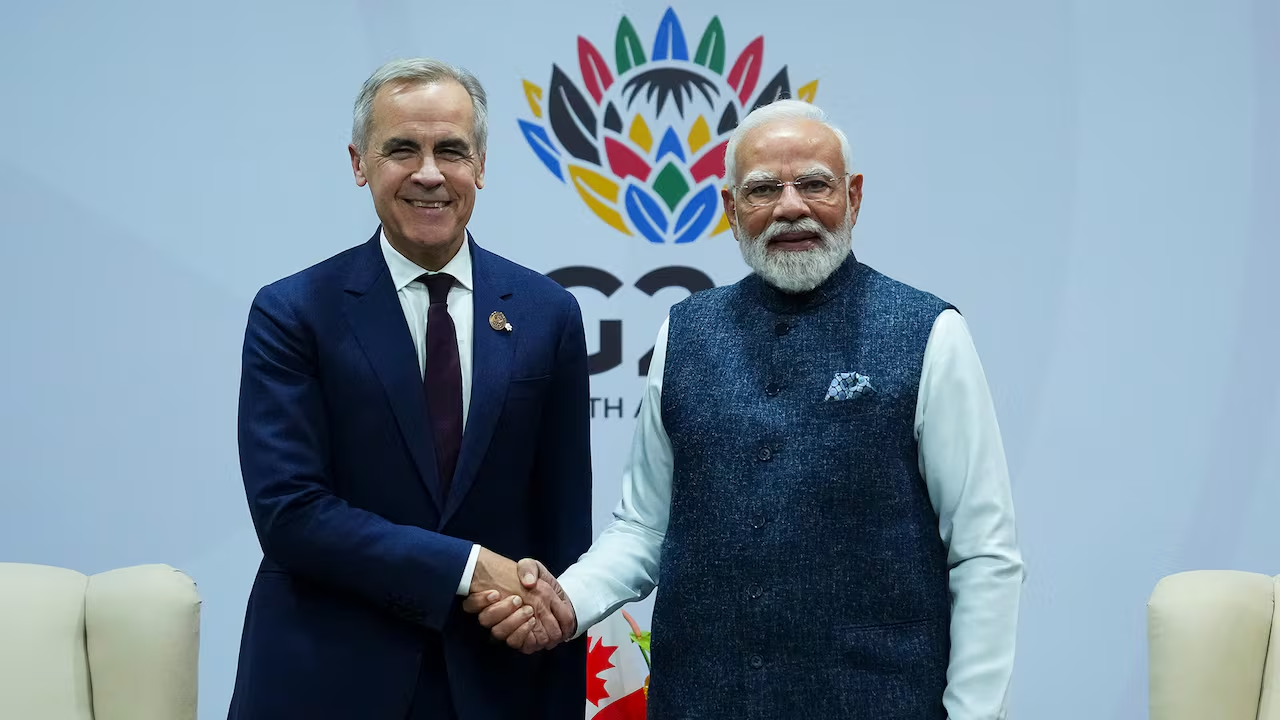
Relations between Canada and India appear to be entering a dramatic new phase as both countries accelerate efforts toward a major free trade agreement expected to significantly reshape economic ties, investment opportunities and strategic cooperation between the two nations.
Canadian Prime Minister Mark Carney described the proposed Comprehensive Economic Partnership Agreement (CEPA) as a potential “game changer” for Canadian workers and businesses following high-level meetings in Ottawa with Indian Commerce and Industry Minister Piyush Goyal.
Carney emphasized that both governments are now moving quickly to finalize a broad economic partnership that could unlock major opportunities in sectors including energy, agriculture, technology, education, aerospace and advanced manufacturing.
In a public statement following the meeting, Carney said Canada and India are “working fast” to deepen cooperation and expand bilateral trade ties.
The visit by Goyal is being viewed as one of the strongest signs yet that Canada and India are actively attempting to rebuild relations after years of diplomatic tensions and stalled negotiations.
India arrived with its largest-ever business delegation to Canada, including more than 100 senior executives representing industries such as mining, energy, automotive manufacturing, aerospace, telecommunications, pharmaceuticals and infrastructure.
The renewed momentum follows Carney’s landmark visit to India earlier this year — the first official trip by a Canadian prime minister to India in eight years.
According to Goyal, Carney’s February visit fundamentally changed the direction of bilateral relations.
“This is a partnership that is being reset very, very rapidly,” Goyal stated during his Ottawa meetings, adding that the relationship is now entering a phase of “complete overhaul” with new strategic goals and expanded economic ambitions.
During the discussions, Goyal also conveyed greetings from Indian Prime Minister Narendra Modi and praised the renewed confidence emerging between both governments.
Canada and India have formally been engaged in trade negotiations since 2010, but discussions collapsed in 2023 after the government of former Prime Minister Justin Trudeau accused Indian agents of involvement in the killing of Sikh activist Hardeep Singh Nijjar outside Vancouver.
India strongly denied the allegations and accused Canada of tolerating extremist elements connected to the Khalistan movement, leading to one of the worst diplomatic crises in Canada-India relations in decades.
The arrival of the Carney government has significantly changed the tone between the two countries.
Carney has made rebuilding strategic and economic relations with India a major foreign policy priority, particularly as Canada seeks to diversify global trade partnerships and reduce economic dependence on the United States amid ongoing global economic uncertainty.
The reset has already produced major economic agreements.
Earlier this year, Canada and India signed a multi-billion-dollar uranium supply agreement valued at approximately 2.6 billion Canadian dollars to support India’s expanding nuclear energy sector.
The deal includes the export of roughly 22 million pounds of uranium from Canada to India and is being viewed as a cornerstone of a broader long-term energy partnership.
Both governments have now established an ambitious goal of increasing bilateral trade to approximately US$50 billion by 2030.
Analysts say the timing of the renewed relationship reflects broader geopolitical and economic shifts affecting both countries.
India is increasingly seeking reliable democratic economic partners as global supply chains shift and energy security concerns grow, particularly following recent instability in the Middle East and disruptions involving the Strait of Hormuz.
Canada, meanwhile, is positioning itself as a stable supplier of energy, critical minerals, agricultural products, uranium and advanced technologies to rapidly growing Asian economies.
Trade experts also note that India offers Canada enormous long-term growth potential through its expanding middle class, infrastructure development and demand for foreign investment and technology partnerships.
In addition to trade negotiations, Goyal’s visit includes meetings with Canadian CEOs, startup leaders, institutional investors and pension fund representatives aimed at expanding private-sector cooperation between the two countries.
Further rounds of CEPA negotiations are expected later this year as officials on both sides work toward securing a formal agreement before the end of 2026.
The rapidly improving Canada-India relationship is now being viewed as one of the most significant diplomatic and economic realignments currently unfolding in Canadian foreign policy.