

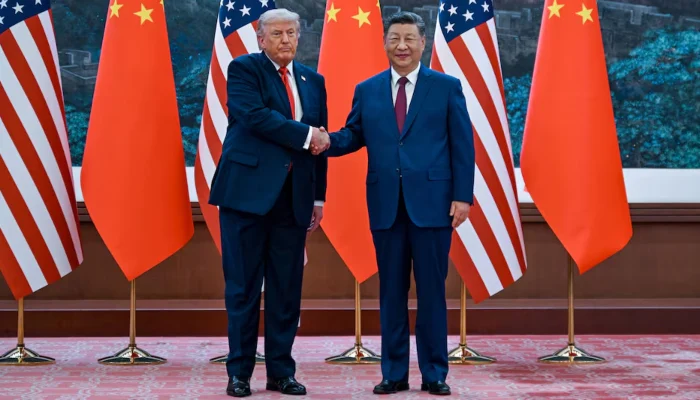
Donald Trump and Xi Jinping opened what Trump described as potentially “the biggest summit ever” during a closely watched two-day meeting in Beijing focused on trade, the Iran conflict, technology and Taiwan.
The summit marks the first visit to China by a sitting U.S. president since Trump’s own previous Beijing trip in 2017 and comes at a sensitive moment for both global markets and geopolitics.
Welcoming Trump at Beijing’s Great Hall of the People with a grand state ceremony, Xi said recent trade negotiations between both countries had reached a “positive outcome.”
“When we cooperate, both sides benefit; when we confront each other, both sides suffer,” Xi said, according to Chinese state media.
Trump responded warmly during the opening session, praising Xi’s leadership and emphasizing the importance of improving relations between the world’s two largest economies.
“You’re a great leader,” Trump told Xi. “It’s an honour to be your friend and the relationship between China and the USA is going to be better than ever before.”
The summit follows recent negotiations in South Korea aimed at preserving the trade truce agreed to last October, when Washington suspended massive tariffs on Chinese imports and Beijing eased pressure on exports of rare earth minerals critical to global industries.
The talks are expected to focus heavily on:
- Expanding trade and investment
- Technology and artificial intelligence
- Semiconductor export restrictions
- Rare earth supply chains
- The Iran conflict
- U.S. arms sales to Taiwan
Several major American business leaders joined Trump’s delegation, including Elon Musk, Jensen Huang and Tim Cook.
Trump has publicly pushed for China to further open its economy to American companies and products, while Beijing is expected to seek relief from U.S. export controls on advanced semiconductors and chipmaking technology.
Analysts say the geopolitical balance between Washington and Beijing has shifted significantly since Trump’s first China visit nearly a decade ago.
At that time, China was still seeking recognition as a rising global power. Now, experts say the U.S. increasingly acknowledges China as a strategic equal in what some analysts describe as a modern “G2” global framework.
The summit also unfolds against the backdrop of rising tensions in the Middle East.
Trump is reportedly seeking Chinese assistance in encouraging Iran to negotiate an end to the ongoing regional conflict and reduce tensions surrounding the strategically vital Strait of Hormuz.
However, analysts believe Beijing is unlikely to pressure Tehran aggressively given Iran’s importance as a strategic partner and energy supplier to China.
Taiwan remains another major flashpoint.
Beijing has strongly opposed a proposed $14-billion U.S. arms package for Taiwan, while Washington continues to maintain its long-standing policy of supporting Taiwan’s self-defence capabilities.
Despite deep disagreements, both sides appear eager to avoid another escalation in economic tensions, particularly as global markets remain sensitive to trade disruptions, inflation and ongoing geopolitical instability.
The summit continues Thursday and Friday with additional meetings, cultural events and a state banquet in Beijing.