

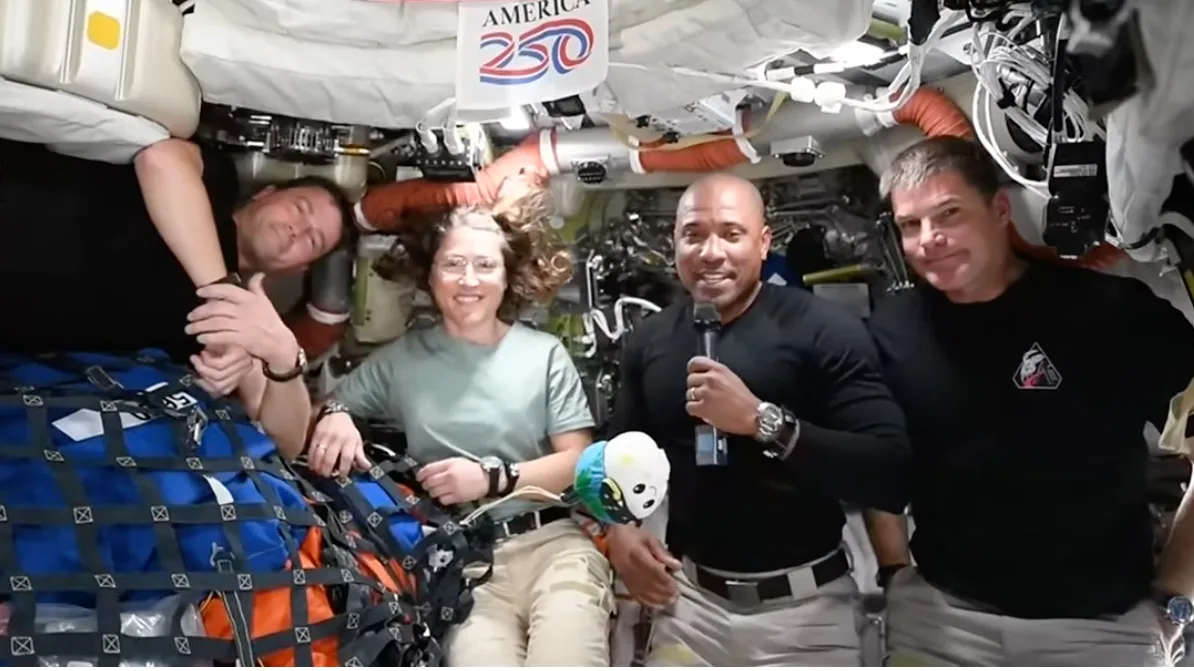
The crew of NASA’s Artemis II mission is preparing to return to Earth after completing a historic journey around the Moon, bringing back what they describe as “all the good stuff” from their groundbreaking observations and discoveries. The four astronauts aboard the Orion spacecraft are expected to splash down in the Pacific Ocean near San Diego late Friday, marking the successful conclusion of a mission that pushed human spaceflight farther than any mission since the Apollo era.
During a live update from space, pilot Victor Glover said the crew has gathered extensive data, images and experiences that will take time to fully process once back on Earth. He emphasized that while some information has already been shared, the most valuable scientific and visual material remains onboard and will be analyzed after recovery. The mission achieved a major milestone by surpassing the distance record previously set during the Apollo 13 flight, traveling farther from Earth than any humans in history.
The crew conducted a lunar flyby, including a rare close observation of the Moon’s far side — a region never visible from Earth. Commander Reid Wiseman described the mission as both scientifically critical and personally meaningful, noting moments of reflection during periods of communication blackout as the spacecraft passed behind the Moon. Astronauts also shared emotional highlights, including naming a lunar crater in memory of Wiseman’s late wife, underscoring the human dimension of the mission.
Canadian astronaut Jeremy Hansen, part of the international crew, contributed to the mission’s symbolic and cultural significance, including moments shared among the crew during their journey through deep space. The astronauts noted that despite the technical challenges and isolation, the experience of exploring beyond Earth reinforced the importance of collaboration, resilience and scientific discovery.
The Orion capsule will now undergo final system checks before re-entry, where it will endure extreme temperatures and speeds approaching 25,000 miles per hour before deploying parachutes for a controlled splashdown. The mission represents a critical step toward future human landings near the Moon’s south pole and continued exploration beyond low Earth orbit.
As the crew prepares to return, anticipation is building for the release of new images, scientific findings and firsthand accounts that are expected to deepen humanity’s understanding of the Moon and pave the way for the next era of space exploration.