

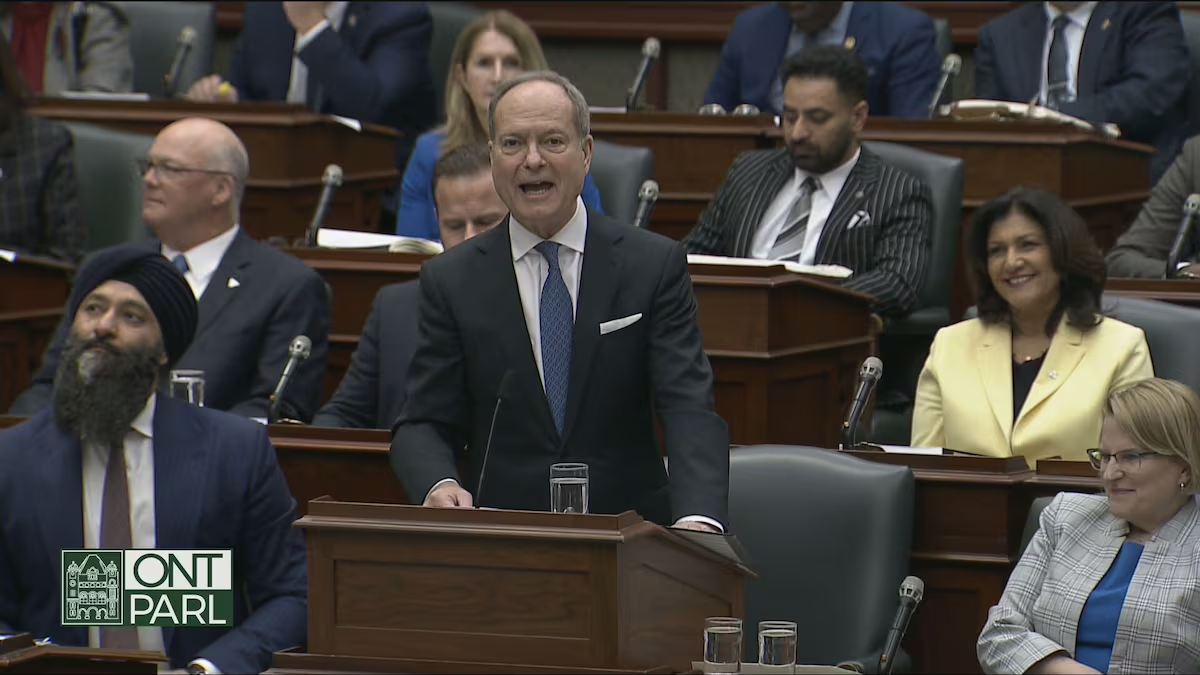
$244.2 billion budget projecting a significantly higher deficit, as the province braces for what officials describe as ongoing economic uncertainty driven by global instability and market pressures.
Finance Minister Peter Bethlenfalvy announced that the province now expects a deficit of $13.8 billion for the 2026–27 fiscal year—nearly double the $7.8 billion projected in last year’s budget. He attributed the increase to shifting geopolitical realities, trade tensions, and continued supply chain disruptions impacting economic performance.
The budget outlines substantial investments across key sectors, including $101.2 billion allocated to health care, $40.8 billion to education, and $14 billion to post-secondary institutions. Despite the growing deficit, the government maintains that increased spending is necessary to protect essential services and stimulate economic growth during uncertain times. Ontario now anticipates returning to balance by 2028–29, projecting a modest surplus of $600 million.
Economic growth is expected to remain modest in the near term, with real GDP projected to grow by one per cent in 2026, rising gradually to 1.7 per cent in 2027 and 1.8 per cent in 2028. Meanwhile, the province’s net debt has reached $485 billion and is expected to surpass $500 billion in the following fiscal year, although the debt-to-GDP ratio is forecast to improve slightly.
The budget introduces several measures aimed at boosting affordability and economic activity, including a temporary removal of the provincial portion of HST on new homes. The move is expected to save buyers up to $130,000 on qualifying properties and cost the province approximately $1.4 billion. In addition, the government will reduce the small business tax rate from 3.2 per cent to 2.2 per cent, benefiting more than 375,000 businesses and delivering an estimated $1.1 billion in tax relief over three years.
A key feature of the plan is the creation of a $4 billion “Protect Ontario Account Investment Fund,” designed to support emerging industries such as artificial intelligence, advanced manufacturing, and data infrastructure. The fund will be managed by a private investment partner, marking a shift toward leveraging private-sector expertise to drive economic development within the province.
The government also announced increased funding for health and social programs, including a boost to the Ontario Autism Program to nearly $1 billion annually and an additional $1.1 billion over three years for home and community care services. In education, $66 million annually will be allocated to provide teachers with classroom supply funding, while broader structural changes are planned for how education property taxes are distributed.
Despite these measures, opposition leaders have criticized the budget, arguing that it does little to address the immediate affordability challenges facing Ontarians. Marit Stiles said the plan fails to provide meaningful relief for families struggling with rising costs, while Ontario Liberal interim leader John Fraser echoed concerns that the budget lacks targeted support for everyday expenses such as housing, energy, and groceries.
As Ontario navigates a complex economic landscape, the 2026 budget reflects a balancing act between fiscal pressure and continued investment, with the government betting on long-term growth strategies to stabilize the province’s finances in the years ahead.