

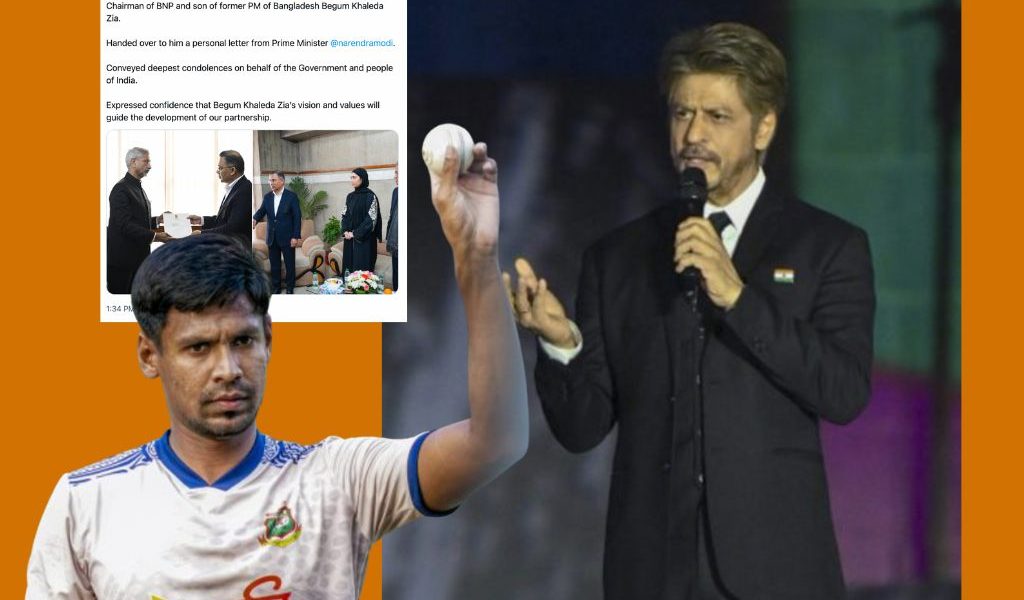
The backlash against Shah Rukh Khan for his Indian Premier League franchise’s decision to sign a Bangladeshi cricketer has exposed what critics describe as deep contradictions in Hindutva politics—particularly in how patriotism and nationalism are selectively defined.
For years, the IPL has projected itself as a global marketplace where nationality, religion and ethnicity recede behind performance and spectacle. Players from across regions and backgrounds have been welcomed so long as they deliver results on the field. That understanding now appears to be under strain.
Khan, owner of the Kolkata Knight Riders, became the target of online attacks after bidding for Bangladeshi fast bowler Mustafizur Rahman. A prominent Hindutva-aligned figure publicly branded the actor a “traitor,” implying that employing a Bangladeshi player amounted to disloyalty to India. The criticism comes amid an approaching West Bengal assembly election, where anti-Bangladeshi rhetoric has become a key campaign theme for the Bharatiya Janata Party.
The episode raises broader questions. If engaging with Bangladeshis is deemed unpatriotic, how should one interpret India’s official diplomatic and economic ties with Bangladesh? India exports goods worth tens of thousands of crores of rupees annually to its eastern neighbour. Indian companies, including energy firms, sell electricity across the border. Senior Indian officials regularly meet Bangladeshi leaders.
Critics point, for example, to India’s external affairs minister S. Jaishankar, who has engaged with Bangladeshi political figures, including those not seen as friendly to New Delhi. They also note that Narendra Modi has maintained close ties with former Bangladeshi prime minister Sheikh Hasina, despite allegations of violence against minorities during her tenure.
If Pakistani players are barred from the IPL on political grounds, some ask why Bangladeshi players are not subject to the same restrictions—and what that implies about the standards being applied. Others question whether such decisions are driven less by national security concerns than by domestic political calculations.
The controversy has also revived criticism of what commentators describe as selective outrage. Violence and discrimination against minorities, they argue, are condemned when they occur across borders but are downplayed or rationalized when they occur within India. Incidents of communal violence in places ranging from Uttarakhand and Uttar Pradesh to Kerala and Madhya Pradesh are cited as examples.
The debate further intersects with ideological claims advanced by Mohan Bhagwat, who has repeatedly stated that all Indians are “essentially Hindus.” Critics contrast this with the absence of comparable claims from religious leaders in Bangladesh that all Bangladeshis are Muslims. Within this framework, they argue, figures like Khan—despite his long career portraying nationalist themes and publicly rejecting religious stereotyping—are still treated as suspect.
Underlying these arguments is a concern about who gets to define patriotism. Detractors warn of a climate in which self-appointed vigilantes determine loyalty, not merely through rhetoric but potentially through law and coercion.
The author draws a literary parallel to Julius Caesar, recalling the mob that kills the poet Cinna not for his politics but for his “bad verses,” as a cautionary tale about mob justice and ideological absolutism.
In a postscript, Raina extends the critique to global politics, suggesting that rising ethno-religious nationalism—from India to the United States—reflects a broader trend. He notes the irony that Modi has received top honours from several Muslim-majority countries, prompting questions about how such international recognition fits with hardline domestic narratives.
Badri Raina taught at Delhi University. This article was first published by The India Cable and has been updated and republished here.