

OTTAWA — Prime Minister Mark Carney’s government has made stricter crime legislation a central focus of its agenda, introducing three major justice bills during Parliament’s fall sitting in response to what it says are growing public concerns about safety.
The proposed measures include a wide range of amendments to the Criminal Code, from making bail harder to obtain for certain offences to imposing mandatory minimum and consecutive sentences. The bills would also create new offences related to intimidation, obstruction, hate promotion and coercive control in intimate partner relationships.
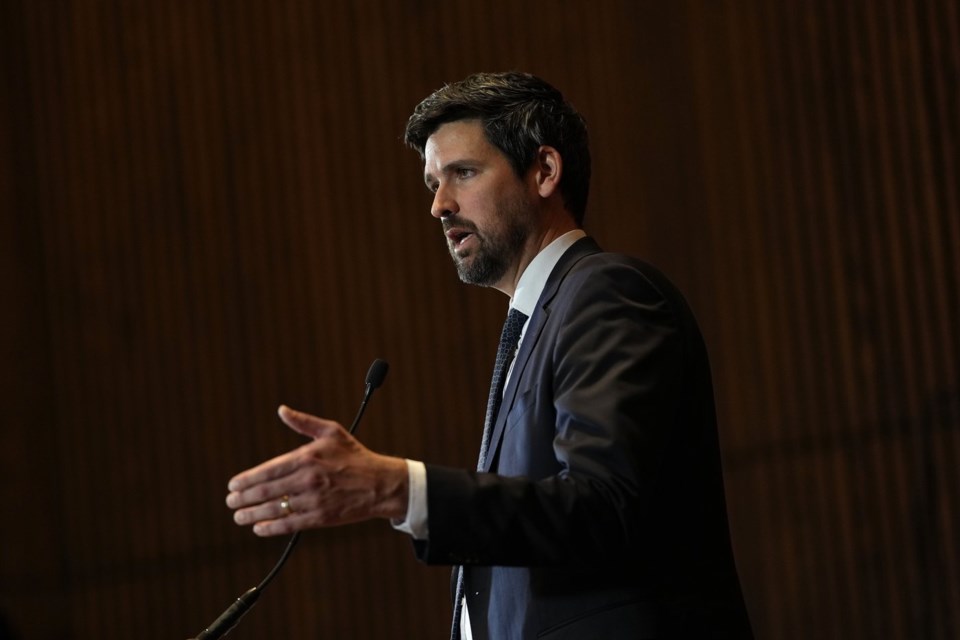
Justice Minister Sean Fraser, who introduced the legislation, said the shift reflects what Canadians are asking for rather than a political rebranding of Liberal crime policy.
“I’ll leave it to others to characterize what’s tough or not tough,” Fraser said in a year-end interview with The Canadian Press. “We are increasing penalties for serious and violent criminals and making it harder for people to be released on bail if they pose a risk to public safety.”
Fraser said crime policy has become a priority for the government because it has become a priority for voters.
“People have been loud and clear. They want the federal government to change the criminal law to ensure that they are protected,” he said, citing concerns about auto theft, home invasions, sexual offences, hate crimes and the exploitation of children.
Three major justice bills
The legislative push began in September with hate crime legislation, Bill C-9, which would create new offences for intimidation and obstruction aimed at protecting places of worship and institutions used by identifiable groups. It would also criminalize the wilful promotion of hate through hate symbols.
In October, the government introduced Bill C-14, which would tighten bail rules for a range of offences, including certain vehicle theft, extortion and human trafficking crimes. The bill proposes a “reverse onus” for bail in those cases, shifting the burden onto the accused to justify their release. It would also allow for consecutive sentencing for repeat violent offences, vehicle theft, break-and-enters, extortion and arson.
The final bill, Bill C-16, was tabled shortly before Parliament rose for the holidays. It would classify killings motivated by control, hate, sexual violence or exploitation as first-degree murder and define such killings as femicide when the victim is a woman. The bill would also create a new offence targeting patterns of coercive or controlling behaviour against an intimate partner.
Bill C-16 would further prohibit the non-consensual distribution of intimate deepfake images and threats to distribute child sexual abuse material. It also proposes restoring mandatory minimum sentences previously struck down by courts, while introducing a “safety valve” that would allow judges to impose lighter sentences where mandatory minimums would amount to cruel and unusual punishment.
The legislation would also require courts to consider remedies other than a stay of proceedings in cases affected by delays, an element that has already drawn constitutional criticism.
Legal and political scrutiny
Critics argue some provisions may violate the Charter of Rights and Freedoms, particularly changes related to bail and trial delays. Others warn the hate crime bill could have unintended consequences for freedom of expression. None of the bills have yet completed the parliamentary process.
University of Toronto law professor Kent Roach said the proposals represent some of the most sweeping criminal justice reforms he has seen in decades.
“These are some of the most significant changes in criminal justice that I’ve seen over my 35-year-plus career,” Roach said, adding that the government has not clearly articulated an overarching philosophy behind the reforms.
“It may be good politics,” he said, “but I’m not sure it’s good in the longer-term interest of the criminal justice system.”
Minority Parliament challenges
The Conservatives have long criticized Liberal justice policies as too lenient and campaigned in the spring election on tougher crime measures. Fraser rejected the idea that the new approach is driven by partisan competition.
“I don’t want to turn the motivation for this into a contest between Liberals and Conservatives,” he said. “It’s Canadians that we’re trying to deliver help to.”
Fraser said the Liberal approach differs from the Conservatives’ by pairing tougher laws with investments in policing, victim services, mental health and addiction supports, housing and programs for at-risk youth.
However, with the Liberals governing in a minority Parliament, passing the bills will require support from at least one opposition party. That task has become more complicated for Bill C-9, after the government agreed to remove a religious exemption from the Criminal Code in exchange for support from the Bloc Québécois.
Fraser dismissed claims that removing the exemption would criminalize religious expression.
“When I see some of my parliamentary colleagues suggest that this will criminalize faith or prevent a religious leader from reading sacred texts, nothing is further from the truth,” he said.
Roach said the sheer scope of the proposed reforms could strain Parliament’s ability to fully scrutinize them.
“They’re three very complex, very large bills,” he said. “I wouldn’t be surprised if committees are somewhat overwhelmed by the extent of these changes.”