

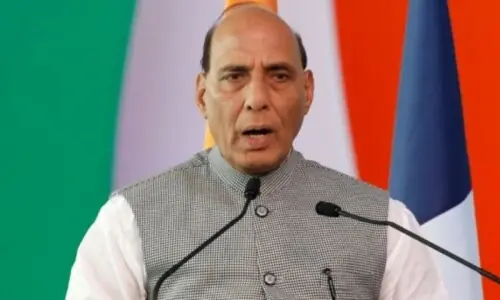
Pakistan’s Foreign Office issued a sharp rebuke on Sunday after Indian Defence Minister Rajnath Singh suggested that Sindh could one day “return to India,” calling his comments “delusional, dangerously revisionist,” and a violation of international norms.
Indian media quoted Singh as saying during an event in Delhi that although Sindh is not part of India today, “civilisationally, Sindh will always be a part of India,” adding that “borders can change” and implying the province might again become part of India in the future. He reportedly told a gathering of the Sindhi community that many Sindhi Hindus “never fully accepted” Sindh’s accession to Pakistan.
Pakistan’s FO condemned the remarks as reflective of an “expansionist Hindutva mindset” and accused Indian leaders of challenging internationally recognised borders and the sovereignty of states. It urged New Delhi to stop using provocative rhetoric for political gain and instead address growing insecurity and discrimination faced by minorities within India.
The FO said India should also confront long-standing grievances in its northeast, where communities “continue to face systematic marginalisation and state-enabled violence.” It reiterated Pakistan’s call for India to take “credible steps” toward resolving the Kashmir dispute in line with UN Security Council resolutions.
Pakistan reaffirmed its commitment to peaceful engagement but warned it would “safeguard its security, national independence and sovereignty” against any threats.
Relations between the nuclear-armed neighbours have sharply deteriorated since a four-day military clash in May—the worst escalation in decades—triggered by an attack on Hindu tourists in occupied Kashmir. India accused Pakistan of involvement, a claim Islamabad has rejected as fabricated.
Both sides used fighter jets, drones, missiles and artillery during the conflict, which ended in a ceasefire after dozens were killed. Pakistan claimed to have downed at least six Indian jets, later raising the number to seven, while India acknowledged some losses but disputed the figures.
In the months since, military and political leaders on both sides have issued increasingly confrontational statements. Earlier in October, Pakistan’s military warned that any future conflict could result in “cataclysmic devastation,” pledging a “resolute” response without restraint.
Indian military chiefs have also escalated rhetoric, with Army Chief Gen. Upendra Dwivedi warning Pakistan to “stop state-sponsored terrorism if it wants to retain its place on the map,” and Air Force Chief Amar Preet Singh asserting—without evidence—that India shot down five Pakistani fighter jets during the May clashes.
Addressing supporters, Rajnath Singh maintained that India’s armed forces have high morale and are fully capable of confronting “any challenge,” from terrorism to conventional threats.