

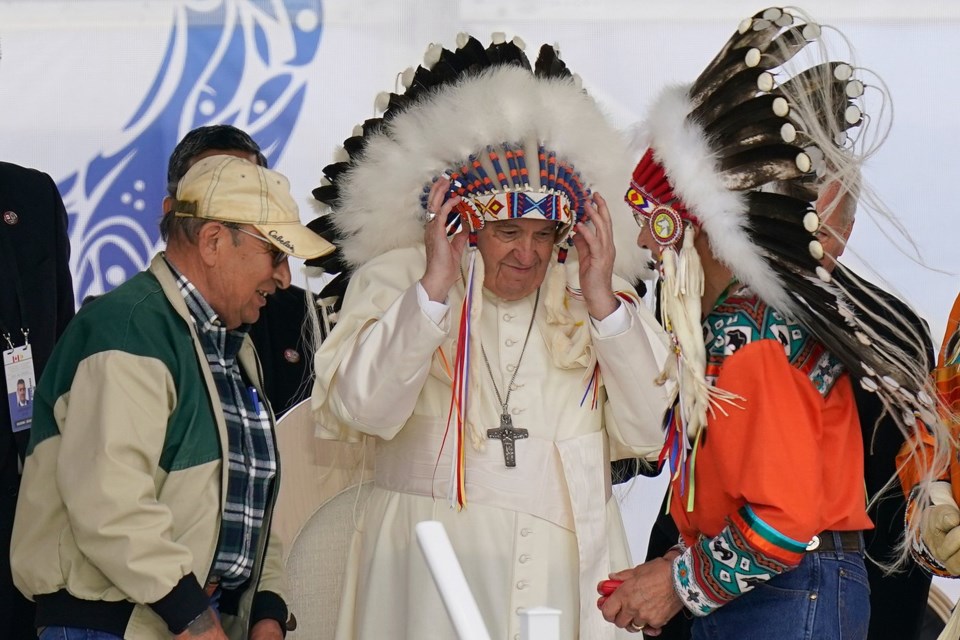
VATICAN CITY — In a landmark gesture of reconciliation, the Vatican has returned 62 cultural artifacts to Indigenous peoples from Canada, acknowledging the Catholic Church’s role in the suppression of Indigenous culture during the colonial period.
The restitution, made on Saturday, marks a significant moment in the Church’s evolving relationship with Indigenous communities in the Americas. Pope Leo XIV formally handed over the artifacts — including a rare and iconic Inuit kayak — to representatives of the Canadian Conference of Catholic Bishops, who will oversee their return to the appropriate Indigenous communities.
A joint statement from the Vatican and Canadian church leaders described the return as a “gift” and a “concrete sign of dialogue, respect and fraternity.” The pieces come from the Vatican Museums’ Anima Mundi ethnographic collection, long the subject of debate due to its colonial-era origins.
Artifacts collected during period of cultural suppression
Most of the items were originally sent to the Vatican by Catholic missionaries for a major 1925 exhibition. Although the Church has maintained that these objects were “gifts” presented to Pope Pius XI, Indigenous groups and historians have questioned whether true consent could have existed given the oppressive environment of the time.
At the height of Canada’s forced assimilation policies — including the residential school system and the 1885 potlatch ban, which criminalized key Indigenous ceremonies — many ceremonial, spiritual, and cultural artifacts were confiscated from Indigenous communities. Some of these items later made their way into museums and private collections across Europe and North America.
Canada’s Truth and Reconciliation Commission has described these actions as part of a broader system of “cultural genocide.”
Return accelerated after Pope Francis’ 2022 apology
Momentum toward restitution increased significantly in 2022 when Indigenous delegations travelled to Rome and received a historic apology from Pope Francis for the Church’s involvement in Canada’s residential schools. During that visit, Indigenous representatives viewed items in the Vatican’s collection — including the kayak, wampum belts, masks and war clubs — and formally requested their return.
In subsequent comments, Francis publicly expressed support for repatriation, stating: “Where it is possible to return things, where it is necessary to make a gesture, better to do it.”
Saturday’s return also coincides with the Vatican’s Holy Year and comes exactly 100 years after the artifacts were first displayed in Rome.
Next steps: Returning items to rightful guardians
The artifacts will initially be transferred to the Canadian Museum of History in Gatineau, Quebec, where experts and Indigenous groups will work together to determine the exact origins of each item and the most culturally appropriate path forward. The Vatican has emphasized that the final custodians of the artifacts will be the Indigenous communities themselves.
Canada’s Ambassador to the Holy See, Joyce Napier, hailed the move as a long-awaited milestone.
“This is historic — something Indigenous communities have been asking for,” she said. “Today’s announcement is a significant step towards reconciliation.”
Part of broader Vatican reckoning
The restitution is the latest step in the Vatican’s ongoing confrontation with its colonial legacy. Last year, the Church formally repudiated the Doctrine of Discovery, the centuries-old papal decrees that European powers used to justify the seizure of Indigenous lands during colonization.
While the Vatican stopped short of rescinding the original papal bulls, the repudiation acknowledged the Church’s complicity in the abuses committed under their authority.
Saturday’s return of Indigenous artifacts, the Vatican said, represents the continuation — and in some ways the culmination — of the “journey” begun with that declaration.