

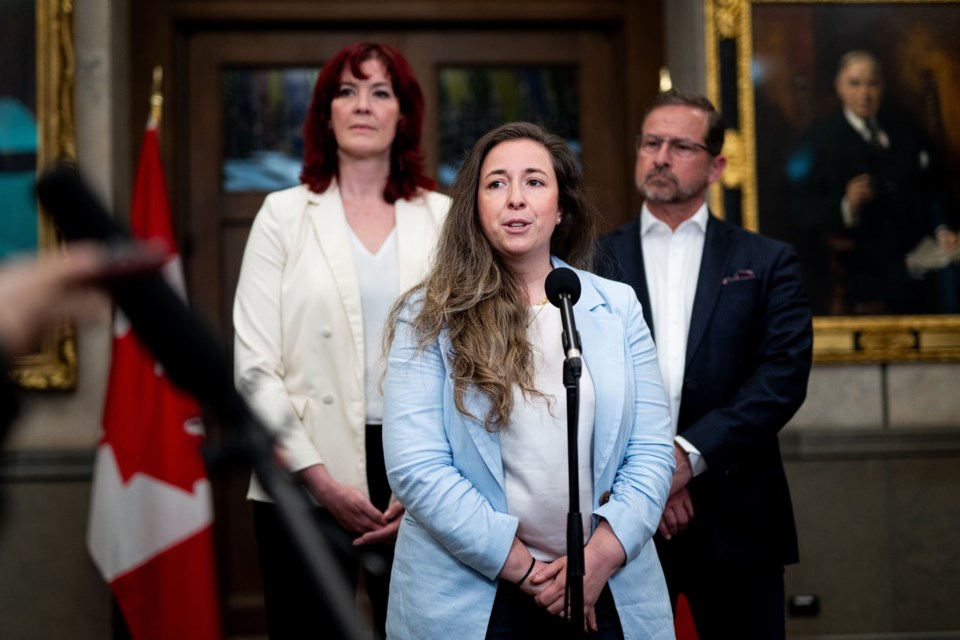
MONTREAL — The lawyer representing Quebec Liberal MP Tatiana Auguste, who won her Terrebonne riding by a single vote in April’s federal election, told a Quebec Superior Court hearing Tuesday that overturning the result over one uncounted ballot would be both “unreasonable” and unfair to tens of thousands of voters who already cast their ballots.
“To cancel the election is to deny the right to vote that was expressed by these 61,115 people,” said Marc-Étienne Vien, Auguste’s lawyer, during arguments in St-Jérôme. He noted that a new vote could effectively disenfranchise voters who have since died or moved away.
The case was brought forward by Bloc Québécois candidate Nathalie Sinclair-Desgagné, who narrowly lost to Auguste after a judicial recount confirmed the Liberal victory by just one vote on May 10. Sinclair-Desgagné challenged the result after learning that a Bloc supporter’s mail-in ballot was never counted because an Elections Canada employee mistakenly printed the wrong postal code on several special ballot envelopes.
Vien told the court that while the error was unfortunate, it was a “banal” human mistake that did not justify nullifying the entire election. “These are things that happen,” he said. “To allow a contestation of elections on this basis doesn’t seem appropriate.” He added that it was unclear whether the single uncounted vote would have changed the outcome.
He further argued that the inclusion of three Bloc-marked ballots found in garbage cans at a polling station raised questions about their validity. If those ballots were disqualified, he said, Auguste’s margin of victory would rise from one vote to four.
Sinclair-Desgagné’s lawyer, Stéphane Chatigny, countered that excluding even one eligible voter constitutes an irregularity serious enough to affect the result. “A one-vote margin represents 0.000016 of the ballots cast,” he said. “That shows the level of uncertainty in the result.”
Elections Canada’s counsel, Daniel Baum, confirmed that the postal code error had occurred but declined to take a position on the legal challenge. He cited a 2012 Supreme Court ruling that established a high threshold for overturning election results based on administrative errors, emphasizing that Canadian elections “are not designed to achieve perfection.”
“It’s a big, complex machine, and errors are inevitable,” Baum said.
The court’s decision will determine whether Terrebonne voters must return to the polls for a new byelection or if the razor-thin Liberal victory will stand.