

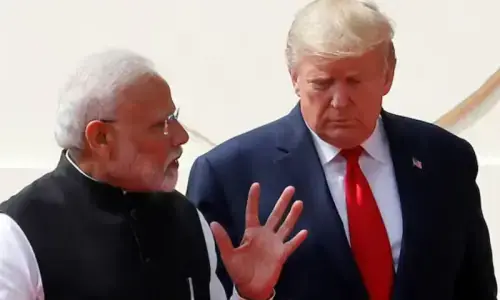
Washington/New Delhi — U.S. President Donald Trump and Indian Prime Minister Narendra Modi struck a hopeful tone this week, raising the possibility of a long-anticipated trade deal despite months of friction over tariffs and Russia’s war in Ukraine.
Trump said on Tuesday that negotiations to address trade barriers with India are continuing and that he expects to speak with Modi “in the upcoming weeks,” predicting that talks would end in “a successful conclusion for both of our Great Countries.” Modi echoed the sentiment on Wednesday, calling the United States and India “close friends and natural partners,” and pledged that both sides were working to wrap up discussions as soon as possible.
The optimism from both leaders lifted Indian shares by more than half a percent, fueling speculation that a breakthrough may finally be within reach. Still, the prospect of a deal comes against a backdrop of heightened tensions. Trump recently doubled tariffs on Indian imports to 50 percent and has accused New Delhi of indirectly funding Russia’s war in Ukraine through its oil purchases. India has denied the charge.
The diplomatic rift has coincided with a notable warming in India’s ties with China. Modi’s first visit to Beijing in seven years saw him clasp hands with both Chinese President Xi Jinping and Russian President Vladimir Putin at a summit last month — an image that unsettled Washington.
Despite Tuesday’s conciliatory messaging, analysts urged caution. “While the social media statements by Trump and Modi signal a potential rapprochement between the U.S. and India, it is still premature to assume that a resolution will arrive swiftly,” said Madhavi Arora, economist at Emkay Global. “With Trump, we will need to wait for more concrete signals that a deal is in the offing.”
Reports suggest Indian and U.S. trade officials could meet later in September to resume in-person negotiations, after an earlier round scheduled for late August was abruptly cancelled. Neither side has confirmed dates.
Two-way goods trade between the countries reached $129 billion in 2024, but the U.S. ran a deficit of $45.8 billion, according to U.S. Census Bureau data. Trump has made narrowing that gap a priority, saying last week that India had offered to slash tariffs on American goods to zero — an offer he dismissed as overdue.
Adding further uncertainty, Trump has also been pressing the European Union to join the U.S. in imposing tariffs of up to 100 percent on imports from India and China, part of a broader effort to choke off Russian oil revenues.
The dual messages — one of reconciliation, the other of hardline economic pressure — highlight the complexity of Washington’s approach as it seeks to balance strategic partnership with India against broader geopolitical ambitions.