

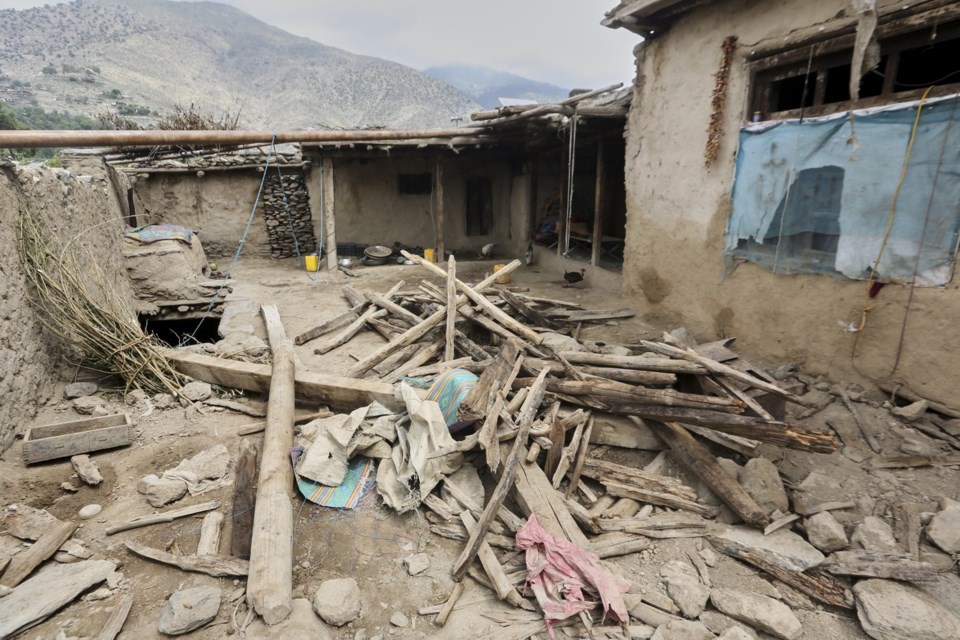
The death toll from a powerful earthquake in eastern Afghanistan has climbed above 1,400, with more than 3,000 people injured, Taliban officials confirmed Tuesday. The 6.0-magnitude quake, which struck late Sunday, flattened villages across several provinces, leaving residents buried under collapsed mud-brick and wooden homes that crumbled under the force of the tremors.
Taliban spokesman Zabihullah Mujahid said the numbers from Kunar province alone reflect the scale of devastation. Rescue efforts have been hampered by mountainous terrain and remote locations, forcing authorities to air drop commandos into areas inaccessible to helicopters. An aftershock of 5.2 rattled the same region on Monday, though no new damage was immediately reported.
The United Nations warned that casualties are expected to rise sharply as rescuers scramble to reach isolated communities. “We cannot afford to forget the people of Afghanistan who are facing multiple crises, multiple shocks,” said Indrika Ratwatte, the UN’s resident coordinator, urging urgent international assistance. He stressed that collapsed mud homes often crush occupants beneath their roofs, a tragedy compounded by the fact that the quake struck at night while families were asleep.
This is the third major earthquake to hit Afghanistan since the Taliban seized power in 2021, adding to the country’s deepening humanitarian crisis. Aid flows have sharply declined due to global funding cuts, sanctions, and opposition to the Taliban’s policies restricting women and girls. Earlier this year, the U.S. scaled back assistance amid concerns of funds reaching the regime.
Despite limited recognition, including from Russia, the Taliban government has appealed for international help. Several countries have responded: the U.K. pledged £1 million through aid groups, the European Union is sending 130 tons of emergency supplies and one million euros in funding, and nations such as India, China, and the United Arab Emirates have promised disaster relief.
On the ground, conditions are dire. The UN’s humanitarian office reported more than 420 health facilities have closed or suspended operations due to funding cuts, with 80 in the quake-hit eastern region alone. The remaining clinics are overwhelmed, understocked, and too far from many affected communities, leaving urgent trauma care out of reach during the critical first 72 hours.
Taliban authorities have set up emergency camps in Kunar to coordinate supplies, transport the injured, and organize burials for the dead. For survivors still trapped in rubble, time is quickly running out.