

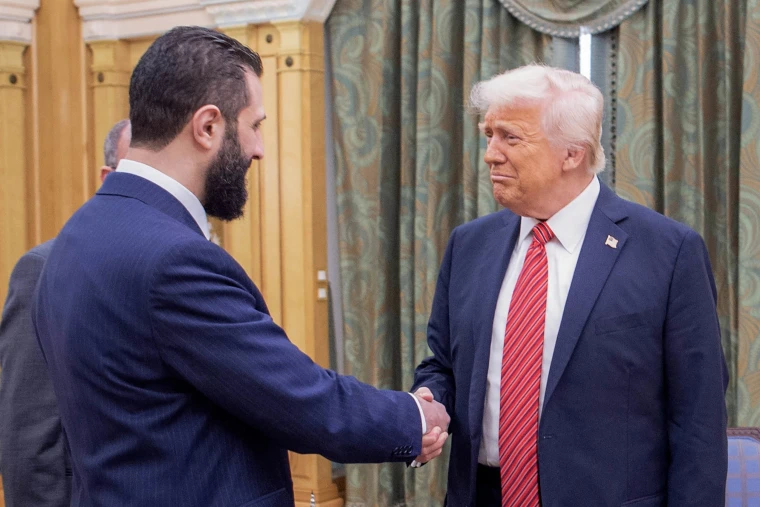
In a day of high-stakes diplomacy and trillion-dollar deals, U.S. President Donald Trump met with interim Syrian President Ahmad al-Sharaa in Saudi Arabia — a meeting that may reshape the political future of Syria and recalibrate Middle East alliances.
This was the first official encounter between U.S. and Syrian leadership in 25 years, taking place on the sidelines of Trump’s summit with Gulf Cooperation Council (GCC) leaders in Riyadh. The visit marked a sharp pivot in U.S. foreign policy as Syria emerges from more than five decades of isolation under the Assad regime.
“Young, attractive guy. Tough guy. Strong past. Fighter,” Trump told reporters aboard Air Force One, referring to al-Sharaa, who once operated under the militant alias Abu Mohammed al-Golani and led an insurgency against U.S. forces in Iraq. He had previously spent years in U.S. detention.
Just a day earlier, Trump had announced the lifting of U.S. sanctions on Syria, prompting celebrations and fireworks across Syrian cities, where citizens hailed the potential return to global financial networks and long-denied foreign investments.
Qatar Aviation Deal Headlines $1.2 Trillion Economic Package
Later in the day, Trump traveled to Doha, where Qatar signed a $96 billion deal with Boeing to purchase up to 210 jets for its national carrier. According to the White House, the aviation and defence agreements — including $38 billion in planned upgrades to Al Udeid Air Base and other military infrastructure — bring the total economic exchange between the U.S. and Qatar to $1.2 trillion.
The defence agreements also cover expanded cooperation, with Qatar agreeing in principle to host new U.S. training and operational deployments.
Trump Urges Syria to Normalize Ties with Israel
During the historic meeting with al-Sharaa, Trump urged Syria to begin the process of normalization with Israel, but “once the country is straightened up,” according to aides familiar with the discussion. The proposal signals a bold geopolitical goal: integrating post-Assad Syria into broader Arab-Israeli peace efforts, similar to the Abraham Accords.
Trump’s recognition of Syria’s new leadership — and encouragement to align diplomatically with the West — is seen as a major foreign policy gamble, with potential economic and security implications across the region.
Warning to Iran: End Proxy Support or No Deal
In his address to GCC leaders, Trump renewed pressure on Iran, declaring his intention to strike a new agreement on its nuclear ambitions — but only if Tehran ends support for militant proxy groups.
“Iran must stop sponsoring terror and verifiably cease pursuit of nuclear weapons,” Trump said. “Only then can we move forward with any real negotiation.”
The statement reaffirmed Washington’s commitment to regional security, even as Trump pursues diplomatic openings with former adversaries.