

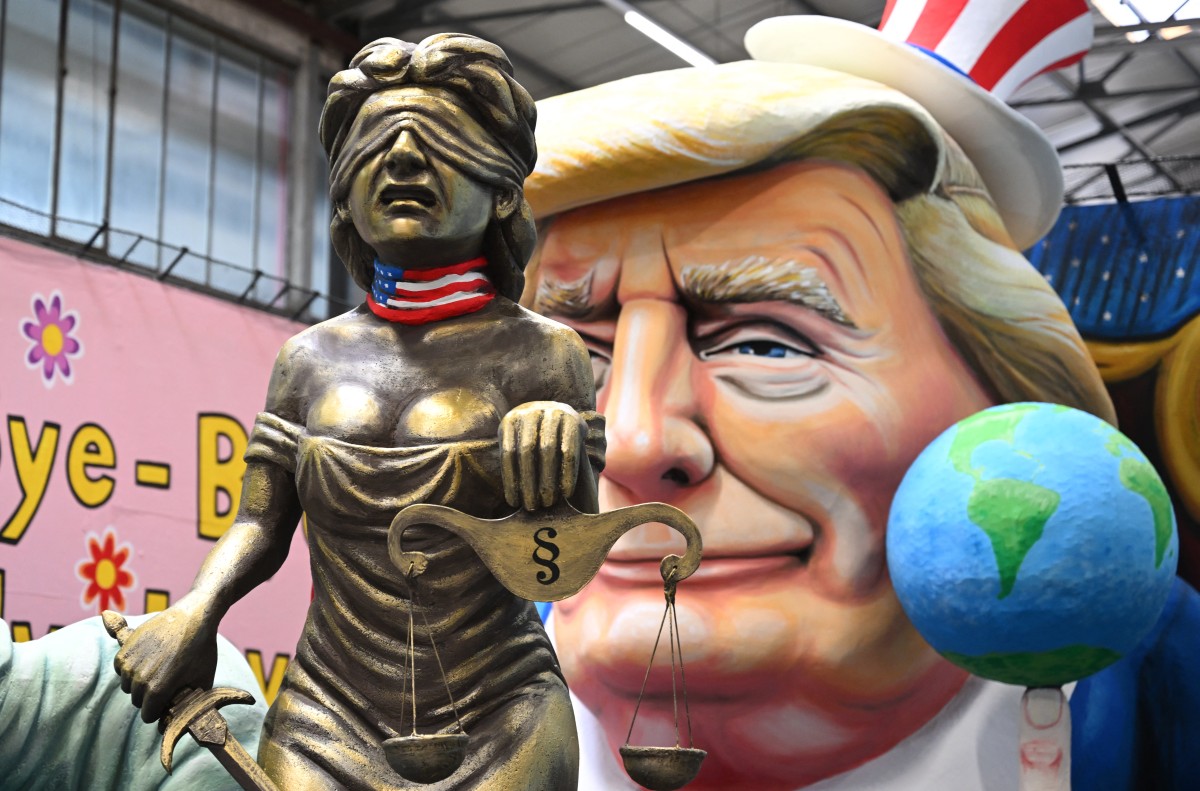
Global financial markets plunged Thursday morning following U.S. President Donald Trump’s sweeping announcement of new tariffs on imports from dozens of countries — a move that analysts warn could trigger a full-blown global trade war and tip economies into recession.
Wall Street responded immediately and sharply. Futures for the S&P 500 fell 3.4%, while the Dow Jones Industrial Average dropped 2.8% and the tech-heavy Nasdaq slumped 3.8% ahead of the opening bell. Major U.S. companies with global supply chains, including Nike, Best Buy, and Dollar Tree, saw pre-market losses exceeding 11%.
The sweeping tariff package includes a 10% baseline tax on all imports, with steeper rates targeted at specific economies. Imports from China will face a crippling 34% tariff, while the European Union and Taiwan will see levies of 20% and 32% respectively. South Korea and Thailand have also been hit, with Bangkok facing a staggering 36% tariff, which analysts estimate could cost the Thai economy up to $8 billion in lost exports.
Canada and Mexico were notably spared from this round of tariffs, though both nations remain cautious in the wake of previous trade tensions.
Oil prices tumbled alongside equities, with U.S. crude falling 4.7% to $68.35 per barrel and Brent crude slipping 4.4% to $71.66. The U.S. dollar, typically a haven in volatile times, fell to its lowest point against the Japanese yen since October, dipping to 146.64 yen.
President Trump defended the tariffs as necessary to restore fairness in global trade and bring manufacturing jobs back to American soil. However, economists from BMO Capital Markets cautioned that this escalation may ultimately harm the U.S. economy as much as its trading partners.
“The concern now is not just higher prices, but the prospect of real damage to economic growth both at home and abroad,” said BMO’s Sal Guatieri and Jennifer Lee in a joint analysis. “We are seeing weakness across equities, commodities, and even gold — traditionally a safe haven — which suggests deepening investor anxiety.”
The bond market reflected similar instability. Yields on 10-year U.S. Treasury bonds plummeted to 4.04% overnight before settling at 4.11%, down from over 4.80% earlier this year, signaling investors’ growing flight to safety.
Markets across Europe followed suit. Germany’s DAX fell 2.4%, France’s CAC 40 slid 2.7%, and the UK’s FTSE 100 dropped 1.5%. In Asia, Japan’s Nikkei briefly fell 4% before closing 2.8% lower, with automakers and financial stocks hit hardest. South Korea’s Kospi fell 1.1%, and Australia’s ASX 200 slipped 0.9%.
While Trump’s latest tariffs aim to protect U.S. industry, the global backlash has been swift, with nations bracing for retaliatory measures and businesses scrambling to adjust supply chains. The coming days will be critical as investors, governments, and industries alike assess the full impact of what could be the most significant disruption to global trade in a generation.