

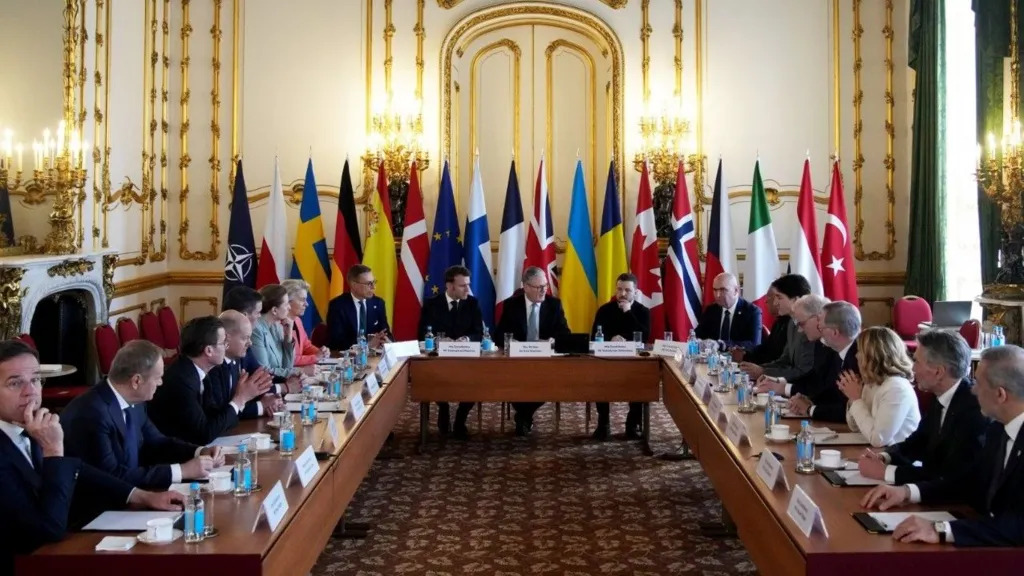
UK Prime Minister Sir Keir Starmer has outlined a bold four-point strategy to bolster Ukraine’s fight against Russia and pave the way for a lasting peace, announcing the formation of a “coalition of the willing” to stand by Kyiv. Speaking after a summit of 18 leaders—predominantly European, alongside Ukraine’s Volodymyr Zelensky—in London on Sunday, Starmer stressed the urgency of the moment, declaring, “We stand at a crossroads in history.”
The announcement follows a contentious White House showdown two days prior between Zelensky and U.S. President Donald Trump, which has heightened tensions in transatlantic relations. Undeterred, Starmer revealed plans to rally international support, including efforts to bring the U.S. on board, while ramping up pressure on Russia.
In a post-summit press conference, Starmer detailed the agreed framework:
- Sustained military aid to Ukraine paired with intensified economic sanctions on Russia.
- A commitment that any peace agreement must safeguard Ukraine’s sovereignty and security, with Kyiv at the negotiating table.
- Post-conflict enhancements to Ukraine’s defenses to prevent future Russian aggression.
- The creation of a “coalition of the willing” to enforce and protect any peace deal.
To underscore the UK’s resolve, Starmer pledged an additional £1.6 billion ($2 billion) in export financing for 5,000 air defense missiles, supplementing a £2.2 billion loan tied to profits from frozen Russian assets. “We cannot repeat past errors with a flimsy deal Russia can shatter at will,” he said. “Strength must underpin any outcome.”
While Starmer did not name all coalition members, he confirmed participants would begin urgent planning. The UK, he added, would contribute “boots on the ground and planes in the air.” He acknowledged Europe’s need to “carry the load” but emphasized that U.S. involvement—and Russia’s inclusion, without dictating terms—remains essential. “We share Trump’s call for a lasting peace,” Starmer said. “Now, we must act together to achieve it.”
Pressed on whether Trump’s administration was an unreliable partner after Friday’s clash, Starmer sidestepped: “No one welcomed what happened, but I reject the idea that the U.S. is anything less than a vital ally.”
The summit, attended by leaders from France, Germany, Poland, Canada, and others, reflected a broader European push to fill gaps left by shifting U.S. policy. European Commission President Ursula von der Leyen called for an urgent “re-arming of Europe,” while NATO Secretary General Mark Rutte hailed the meeting as a sign of Europe “stepping up” to ensure Ukraine’s resilience.
The gathering capped a whirlwind diplomatic week, shadowed by Friday’s U.S.-Ukraine confrontation. There, Trump accused Zelensky of risking “World War Three” and falsely claimed Ukraine initiated the conflict—ignoring Russia’s full-scale invasion on February 24, 2022. Trump, who has voiced confidence in Russian President Vladimir Putin and pursued separate U.S.-Russia talks excluding Ukraine, has vowed to end the war, unsettling many Western allies.
Zelensky, warmly received by King Charles earlier Sunday, continues to rally support as Europe braces for a potential transatlantic rift.