

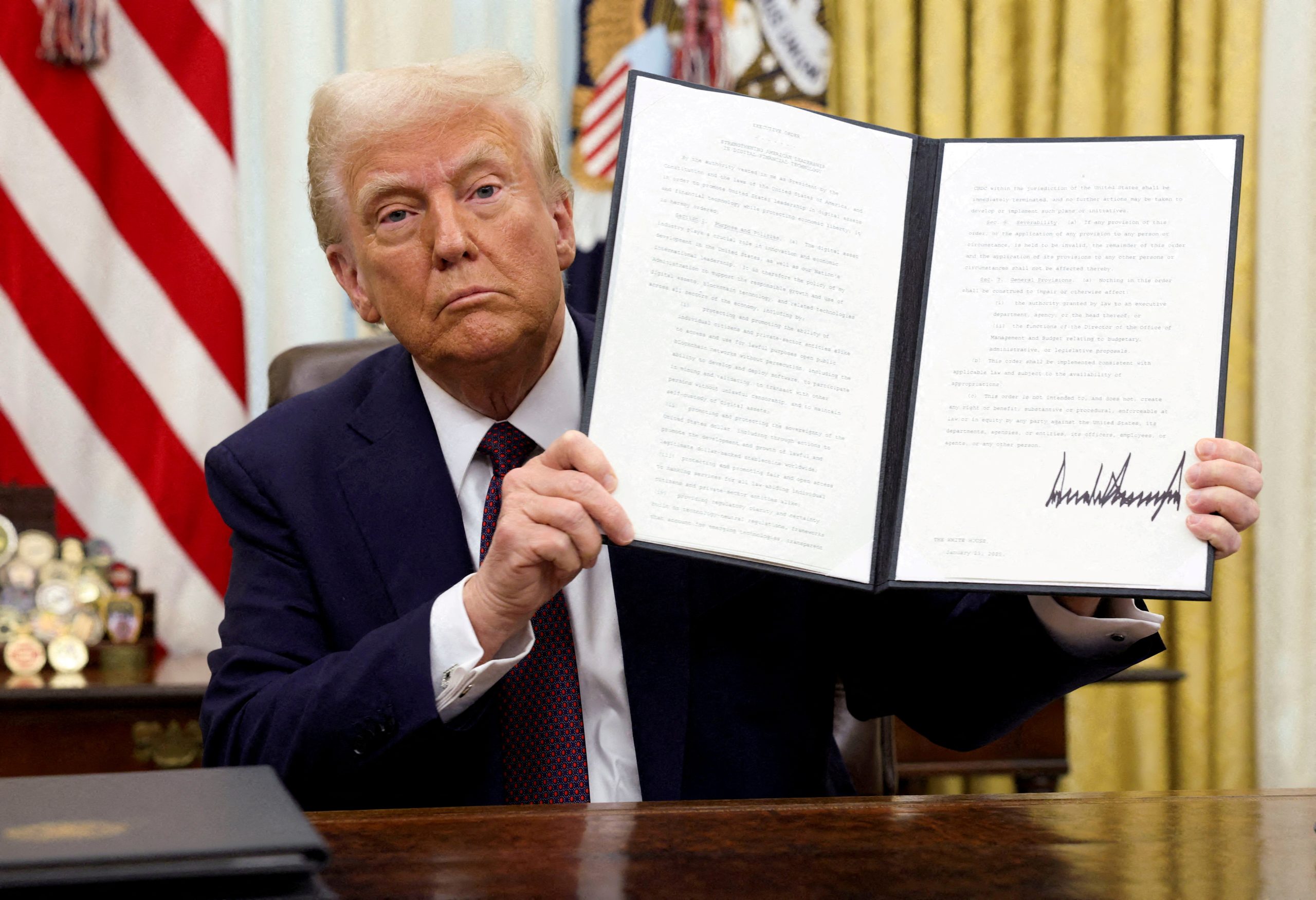
President Donald Trump is set to sign an executive order Friday declaring English the official language of the United States, a first in the nation’s nearly 250-year history, White House officials confirmed. The move will also ditch a decades-old mandate requiring federal agencies to offer language assistance to non-English speakers, sparking debate over unity versus exclusion.
White House insiders say the order aims to streamline government operations and forge a stronger national identity. It reverses a 2000 policy from President Bill Clinton, which compelled agencies and federally funded programs to accommodate those with limited English proficiency (LEP). Going forward, agencies can still opt to provide translation services, but it’s no longer required.
About 68 million of the U.S.’s 340 million residents speak a language other than English, per the U.S. Census Bureau, from Spanish and Chinese dialects to over 160 Native American tongues. Another million rely on American Sign Language, experts estimate. Despite this linguistic tapestry, English has never been legally crowned the nation’s language—until now.
Republicans have long championed English as the official language, with House members pitching bills as recently as 2021 that fizzled out. Critics argue it’s unnecessary—English already dominates—and warn it could fuel discrimination against non-English speakers. They point to the Founding Fathers, who, despite drafting the Constitution in English, left the issue open to embrace German-speaking settlers and others.
Trump’s rhetoric has often tied language to his hardline immigration stance. “We’ve got languages pouring in—stuff nobody here can even teach,” he told supporters in February 2024. “It’s crazy, horrible—languages we’ve never heard of.” Back in 2016, he doubled down: “This is America. We speak English. You’ve got to speak English!”
Globally, 180 countries name official languages—many recognizing multiple, like Canada with English and French. The U.K., like the U.S. until now, has no formal pick. Within the U.S., over 30 states already call English their official tongue, while Alaska and Hawaii honor Native languages too. After English, Spanish, Chinese variants, Tagalog, Vietnamese, and Arabic top the list of languages spoken nationwide.
Friday’s order lands as a bold stroke in Trump’s agenda, echoing his campaign vows. Whether it binds the nation tighter or frays its diverse edges remains the question buzzing from coast to coast.