

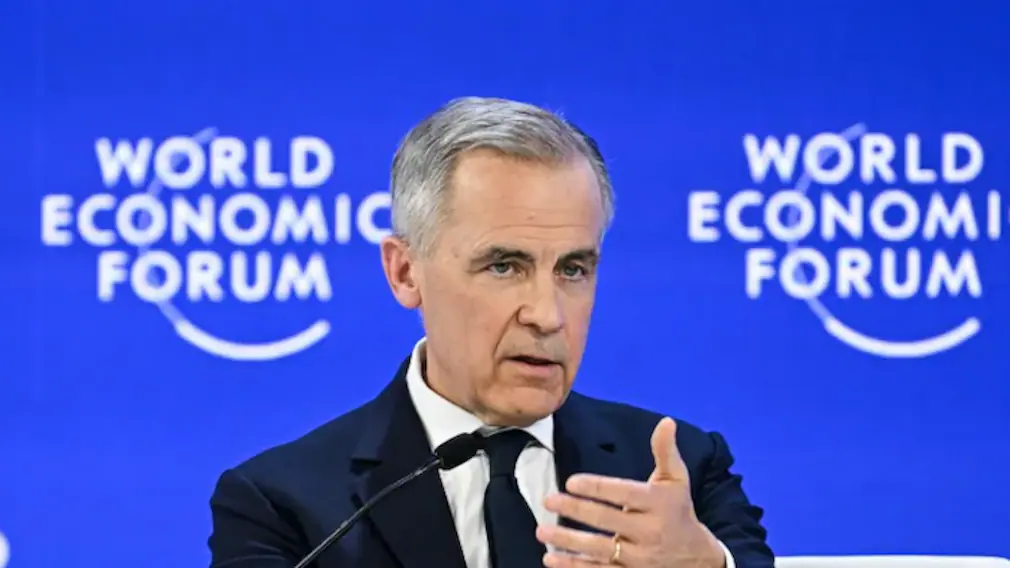
Prime Minister Mark Carney’s speech at the World Economic Forum this week landed with the force of a geopolitical wake-up call, arguing that the old rules-based international order has fractured and that countries without power or alliances risk being sidelined. His blunt message — that while hegemons can act alone, everyone else is “on the menu” if they are not at the table — resonated far beyond Canada and deserves close attention in India.
Carney’s diagnosis reflects a world increasingly shaped by transactional power politics, particularly under U.S. President Donald Trump’s approach to trade and diplomacy. Economic integration, once sold as a shared good, is now routinely weaponized through tariffs, sanctions and financial chokepoints. For India, this reality is neither new nor abstract. New Delhi has already acted on similar instincts, from staying out of RCEP to advancing its Atmanirbhar Bharat strategy, long before “de-risking” became fashionable in Western capitals.
The Canadian leader’s prescription — build strength at home, diversify partnerships abroad and form flexible, issue-based coalitions — offers a useful mirror for India’s own trajectory. His call for middle powers to band together highlights the growing leverage of countries that are neither superpowers nor satellites. For India, cooperation with partners such as Canada, Japan, Europe and ASEAN can help secure energy, critical minerals and technology supply chains while avoiding dependence on any single bloc.
Yet India’s scale and responsibilities demand a more expansive role than Carney’s framework alone provides. With 1.4 billion people and deep ties across the Global South, India cannot merely join a middle-power coalition; it must anchor one. Its influence in Africa and Southeast Asia, and its ability to offer a development model distinct from both Western conditionality and Chinese coercion, remain central to its global standing. Strategic autonomy, not alignment for its own sake, remains New Delhi’s guiding principle.
Where Carney speaks for a country of 40 million, India must balance partnerships with pragmatism — including a nuanced relationship with Russia and a wary one with China, shaped by geography and security realities Canada does not face. Multi-alignment, whether through the Quad, BRICS or bilateral ties, is not indecision but insurance in a fragmented world.
Carney’s most compelling insight may be that nostalgia is not a strategy. The institutions of the late 20th century will not reliably shield national interests in their current, weakened forms. Power today flows from economic resilience, credible supply chains, technological capability and domestic strength. On that measure, India’s task is clear: formalize its economy, skill its youth and build a manufacturing and innovation base robust enough to withstand external pressure.
India should welcome Carney’s candour and join him in shaping new trade corridors and partnerships. But it should also recognize its own advantage. In a world of fortresses and shifting alliances, India does not just need a seat at someone else’s table — it has the capacity to build one of its own.