

“I’ve waited 40 years for this,” says U.S. president as tariffs shake global economy
First, Donald Trump hit Canada and Mexico. Now, he’s declared a global economic war, slapping tariffs on countries across the world in what experts are calling the most aggressive trade assault in modern history.
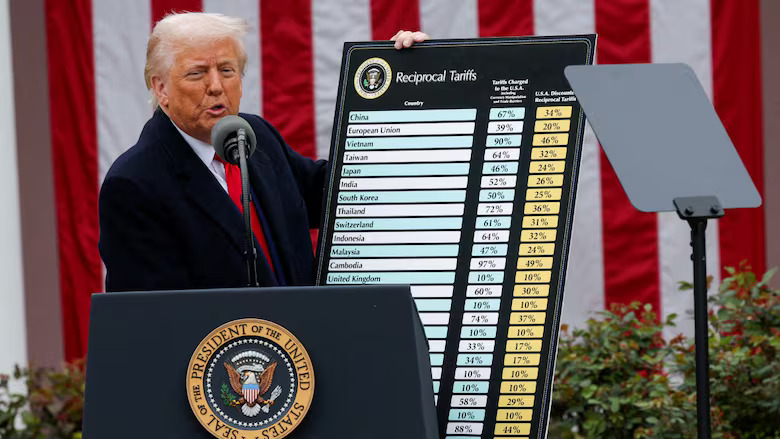
Standing on the White House lawn with a chart in hand, the U.S. president unveiled a sweeping new list of tariffs — from 10% to 50% — aimed at upending the postwar global trade order.
“It’s such an honour to finally be able to do this,” Trump said, grinning. “I’ve been talking about it since I was young, very handsome.”
Canada Not on Trump’s List — But Still Feeling the Heat
Canada was not on the new tariff list, but don’t pop the champagne just yet. Ottawa still faces a web of previously announced tariffs, including:
- 25% on fully assembled vehicles and key auto parts
- 10% on energy and potash
- 25% on steel and aluminum
The auto sector — Canada’s largest manufacturing industry — is bracing for serious disruption.
“It’s going to be a hell of a time,” said Jayson Mercier, an Ontario auto worker. “We’re back in 2008 territory — nobody knows if they’ll still have a job.”
Flavio Volpe, head of Canada’s auto-parts lobby, warned online:
“The. Auto. Tariff. Package. Will. Shut. Down. The. Auto. Sector. Math, not art.”
Even goods exempted under USMCA rules might still face hurdles, depending on the level of U.S.-made content.
The president’s sweeping measures come with strange inconsistencies. Trump’s new tariffs include:
- 46% on Vietnam
- 49% on Cambodia
- 32% on Taiwan
- 26% on India
- 34% on China
Oddly, even uninhabited territories like the Heard and McDonald Islands (part of Australia) were slapped with a 10% tariff.
Meanwhile, countries in Latin America mostly got a break with a flat 10% levy, signalling a geopolitical pivot away from Asia.
“Huge geopolitical implications,” said trade expert Chad Bown of the Peterson Institute. “But uncertainty remains — supply chains don’t realign overnight.”
As Trump touted his tariffs, the U.S. Senate — led by Republicans — held a symbolic vote condemning the move.
“Taxation without representation is tyranny,” said Senator Rand Paul, ripping into Trump’s actions. “Conservatives used to believe tariffs were taxes on Americans. What happened?”
The resolution passed the Senate 51-48, but it’s dead on arrival in the House, and Trump has already vowed to veto it.
Back in Ottawa, Prime Minister Mark Carney paused his re-election campaign to huddle with cabinet. His message was clear:
“We will fight these tariffs with countermeasures. We’re going to protect our workers and build the strongest economy in the G7.”
Carney also announced plans to meet with Trump after the election to renegotiate a new economic and security partnership — and put an end to the escalating hostilities.
Economists warn the fallout could be seismic. Canada’s forest industry is bracing for collapse. Consumer prices are expected to rise. And confidence in the U.S.-led global trading system is badly shaken.
With Trump’s tariff storm hitting just weeks before Canada’s election, his actions are now a central campaign issue — one that could reshape North America’s political and economic future.