

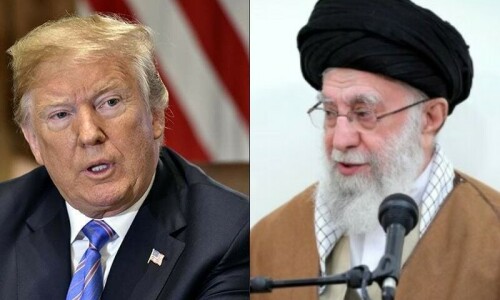
In a dramatic escalation of rhetoric amid a deepening military conflict between Iran and Israel, U.S. President Donald Trump on Tuesday warned Iran’s Supreme Leader Ayatollah Ali Khamenei that the United States knows his location but will not “take him out — for now.” Speaking aboard Air Force One after abruptly leaving the G7 summit in Canada, Trump posted on his Truth Social platform, calling for Iran’s “unconditional surrender” and signaling growing U.S. impatience.
“We know exactly where the so-called ‘supreme leader’ is hiding,” Trump wrote. “He is an easy target, but is safe there — We are not going to take him out (kill!), at least not for now. But we don’t want missiles shot at civilians, or American soldiers. Our patience is wearing thin.”
The remarks come as Israel and Iran enter the fifth day of a spiraling air war. Iran launched a barrage of missiles at Israel on June 16, killing 11 people. In response, Israel has carried out massive retaliatory strikes against Tehran’s nuclear facilities, military sites, and urban areas, reportedly killing top commanders and civilians. Explosions rocked Tehran, briefly knocking Iran’s state broadcaster off the air.
Trump’s comments have fueled speculation that the U.S. may be edging closer to military involvement, despite his administration’s insistence that it has not participated in the conflict so far. “We have complete and total control of the skies over Iran,” Trump declared, referring to the role of U.S.-made weaponry without directly naming Israel.
Trump, who has taken a hardline stance, also criticized French President Emmanuel Macron for cautioning against regime change in Iran. “I want a real end, not a ceasefire,” Trump told reporters. He said he is weighing whether to send Vice President JD Vance or U.S. Middle East Envoy Steve Witkoff to meet Iranian officials, though he added that “it depends what happens when I get back.”
Vance later stated that Trump “may decide further action is needed to end Iranian enrichment,” suggesting U.S. intervention remains a real possibility.
The White House has convened emergency meetings with the National Security Council to assess the situation. Meanwhile, the Pentagon is ramping up its regional military posture, deploying more fighter jets—including F-16s, F-22s, and F-35s—extending missions already underway, and sending the USS Nimitz aircraft carrier toward the Indian Ocean. Four B-52H Stratofortress bombers, capable of carrying nuclear or precision-guided weapons, were also spotted at the Diego Garcia base, according to satellite imagery.
State Department spokesperson Tammy Bruce confirmed the establishment of a Middle East task force to support U.S. citizens and embassies, while declining to comment on military decisions. “That’s for the president to decide,” she said.
As global tensions rise, twenty Muslim-majority nations have jointly called for an end to Israel’s hostilities and urged Middle Eastern countries to recommit to the Nuclear Non-Proliferation Treaty. At the same time, some foreign governments are advising their citizens to evacuate Iran as missile strikes intensify and the threat of a broader war looms.
Inside the U.S., opposition to military escalation is building. Republican Rep. Thomas Massie and Democrat Ro Khanna introduced a War Powers Resolution to prohibit U.S. involvement in the Israel-Iran conflict, arguing, “This is not our war. Even if it were, Congress must decide such matters according to our Constitution.”
The conflict continues to evolve by the hour, with both diplomatic efforts and military deployments escalating. The world now waits to see whether Trump’s warnings are part of a pressure campaign—or a prelude to direct U.S. involvement.