

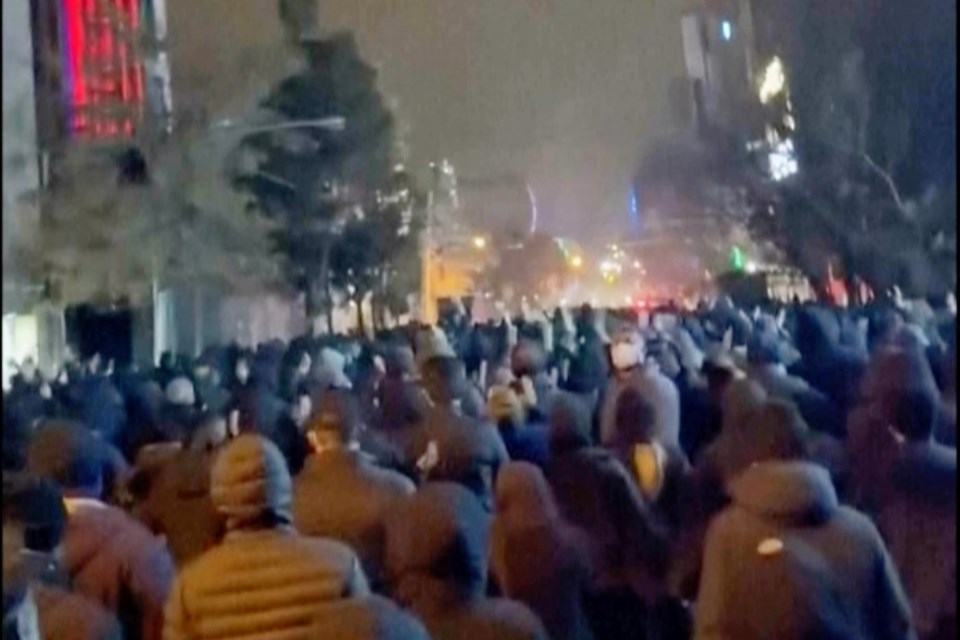
DUBAI, United Arab Emirates (AP) — U.S. President Donald Trump said Iran wants to negotiate with Washington following his warning that the United States could strike the Islamic Republic over its violent crackdown on protesters, as activists reported Monday that at least 544 people have been killed in nationwide demonstrations.
Iran did not immediately respond to Trump’s remarks, which came after Oman’s foreign minister — whose country has long served as an intermediary between Washington and Tehran — visited Iran over the weekend. It also remains unclear what concessions Iran could offer, particularly as Trump has set strict demands related to Tehran’s nuclear program and ballistic missile arsenal, which Iranian officials say are essential to national defense.
Iranian Foreign Minister Abbas Araghchi told foreign diplomats in Tehran that the situation was “under total control,” blaming Israel and the United States for the violence without providing evidence. His comments were carried by Qatar-based Al Jazeera, which has been allowed to report live from inside Iran despite a nationwide internet shutdown.
“That’s why the demonstrations turned violent and bloody — to give an excuse to the American president to intervene,” Araghchi said.
At the same time, Araghchi said Iran remained “open to diplomacy.” Foreign Ministry spokesperson Esmail Baghaei added that a channel to the U.S. was still open, but stressed that any talks must be “based on the acceptance of mutual interests and concerns, not a negotiation that is one-sided, unilateral and based on dictation.”
On Monday, Iranian authorities mobilized tens of thousands of pro-government supporters in demonstrations backing the country’s theocratic leadership, following days of protests that directly challenged the rule of 86-year-old Supreme Leader Ayatollah Ali Khamenei. State television broadcast images of large crowds chanting “Death to America!” and “Death to Israel!”
Other chants included “Death to the enemies of God!” — a charge Iran’s attorney general has said prosecutors could bring against protesters, an accusation that carries the death penalty.
Trump acknowledges proposal for talks
Trump and his national security team are weighing a range of possible responses to Iran, including cyberattacks and direct military strikes by the U.S. or Israel, according to two people familiar with internal White House discussions who spoke on condition of anonymity.
“The military is looking at it, and we’re looking at some very strong options,” Trump told reporters aboard Air Force One on Sunday night. Asked about potential Iranian retaliation, he said: “If they do that, we will hit them at levels that they’ve never been hit before.”
Trump said his administration was working to arrange a meeting with Tehran but suggested action could come first as reports of rising casualties continue and arrests mount.
“I think they’re tired of being beat up by the United States,” Trump said. “Iran wants to negotiate.”
“The meeting is being set up,” he added. “But we may have to act because of what’s happening before the meeting. Iran called — they want to negotiate.”
Iran, through its parliamentary speaker, warned Sunday that U.S. forces and Israel would be considered “legitimate targets” if Washington uses force to protect demonstrators.
According to the U.S.-based Human Rights Activists News Agency, more than 10,600 people have been detained during the two weeks of unrest. The group reported that 496 protesters and 48 members of the security forces were among the dead. The organization relies on a network of sources inside Iran and has been considered reliable during previous periods of unrest.
With the internet largely shut down and phone lines disrupted, it has become increasingly difficult to independently verify events inside Iran. The Associated Press has not been able to confirm the figures, and Iranian authorities have not released official casualty numbers.
Activists fear the information blackout has emboldened hard-liners within Iran’s security forces to intensify the crackdown. Protesters filled streets in Tehran and the country’s second-largest city Saturday night into Sunday, with videos circulating online showing continued demonstrations into Monday. A Tehran official acknowledged renewed protests in state media.
State television showed images Monday afternoon of demonstrators moving toward Enghelab Square — also known as Islamic Revolution Square — in central Tehran. Officials framed the gathering as an “Iranian uprising against American-Zionist terrorism,” without addressing widespread public anger over Iran’s struggling economy.
Fear grips Tehran
Residents in Tehran described a climate of fear, with streets largely empty by nightfall. One witness told the AP that roads clear out around sunset prayers and remain deserted through the evening.
Authorities have sent text messages warning residents against participating in demonstrations. One message cautioned families about “terrorist groups and armed individuals” and said security forces would respond decisively to unrest. Another message, attributed to the intelligence arm of the paramilitary Revolutionary Guard, urged parents to keep their children off the streets and warned of severe consequences for those accused of cooperating with protesters.
The witness spoke on condition of anonymity due to concerns over reprisals.
The protests began Dec. 28 following the collapse of Iran’s currency, with the rial trading at more than 1.4 million to the U.S. dollar, as the economy struggles under international sanctions linked in part to Iran’s nuclear program. What started as economic protests have since escalated into open challenges to Iran’s theocratic system of rule.