

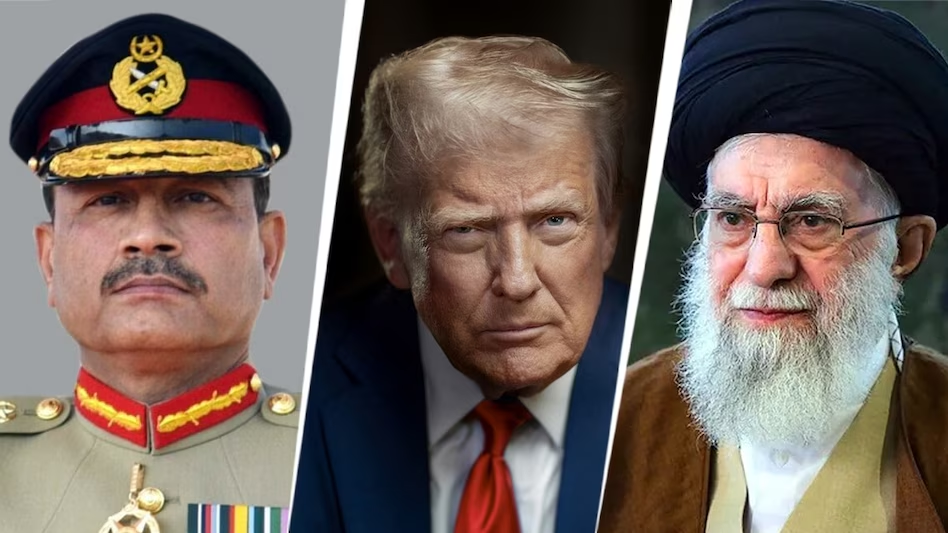
In a move that has drawn international attention, former U.S. President Donald Trump has visibly shifted diplomatic focus toward Pakistan, hosting Pakistan Army Chief General Asim Munir for a high-profile lunch meeting at the White House. This comes amid heightened tensions in South Asia following the recent India-Pakistan military flare-up, and the ongoing Israel-Iran conflict in the Middle East.
While Indian Prime Minister Narendra Modi has categorically denied Trump’s repeated claims of brokering the recent ceasefire with Pakistan, Trump continues to credit himself for “stopping a war” between the two nuclear neighbors. His remarks, combined with the special invitation extended to General Munir, underscore Washington’s renewed strategic interest in Pakistan—particularly in the context of regional security dynamics.
According to diplomatic sources, Pakistan’s geographic proximity to Iran, its nuclear capabilities, and its military infrastructure make it a key player in U.S. defense planning. The U.S. is reportedly exploring options for access to Pakistani airbases and intelligence coordination, especially as tensions with Iran escalate. Trump’s National Security Council recently discussed contingency plans for Iran, reinforcing the value of Pakistan as a logistical ally.
“We are in a more dangerous and divided world,” a senior U.S. official noted. “Pakistan offers the geographic advantage and military readiness that few others in the region can match.”
While India remains a vital partner for trade and strategic alignment in the Indo-Pacific, Trump’s recent moves indicate a more transactional and tactical engagement with Pakistan, particularly in military terms. Analysts believe the United States sees Pakistan as a launchpad for regional countermeasures—from Iran to Afghanistan.
The private lunch meeting with General Munir is symbolic of this shift. Such exclusive access is rare for military officials from South Asia and highlights the seriousness of America’s intent to revive military cooperation with Pakistan amid new geopolitical realities.
Trump’s emphasis on Pakistan is expected to recalibrate regional dynamics, placing Islamabad in a stronger negotiating position, while raising concerns in New Delhi over perceived diplomatic sidelining.
As Iran’s nuclear ambitions continue to cause international unease and Pakistan’s strategic footprint gains renewed relevance, Trump’s pivot signals a reshaped U.S. security doctrine—built on access, readiness, and regional deterrence.