

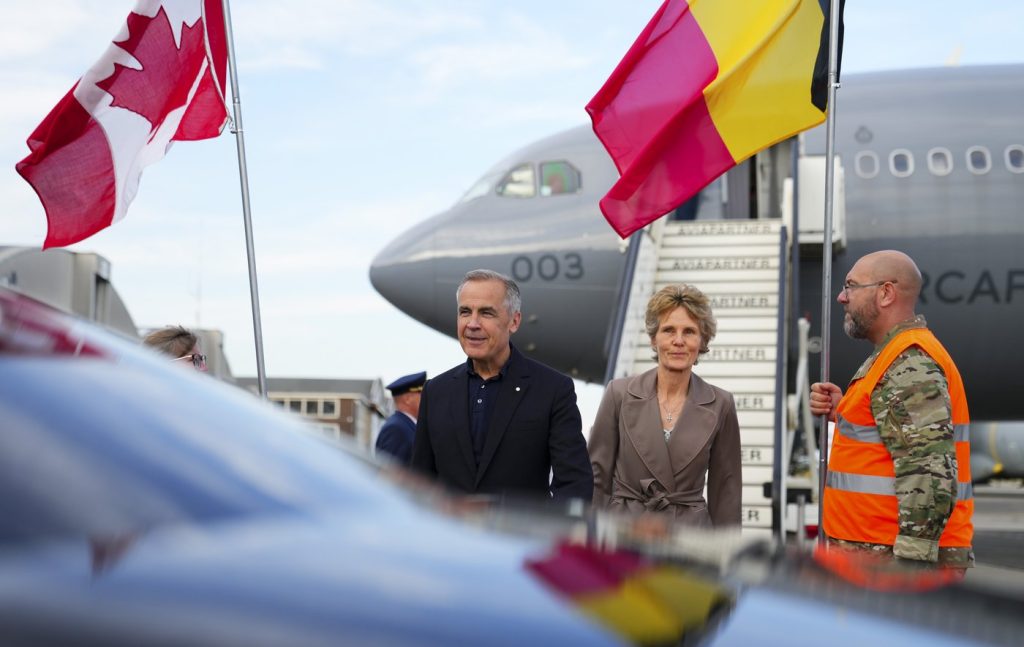
Prime Minister Mark Carney is in Belgium for the EU-Canada summit, where a sweeping new partnership on security, defence, and trade is expected to redefine Canada’s relationship with Europe and reduce its dependency on U.S. military procurement.
Carney began his visit with a solemn stop at Antwerp Schoonselhof Military Cemetery, where 348 Canadian soldiers are buried, paying tribute to Canada’s historic role in European defence. He later met with key European leaders including Belgian Prime Minister Bart De Wever, European Council President António Costa, and European Commission President Ursula von der Leyen.
“We’re launching a new era of partnership — for workers, for businesses, and for the security of both sides of the Atlantic,” Carney said in a post on X.
A centrepiece of this summit is the signing of an ambitious security and defence agreement, described by EU officials as one of the most significant deals ever signed with a non-EU country. Foreign Affairs Minister Anita Anand and Defence Minister David McGuinty are expected to sign the agreement, which opens the door for Canada’s participation in joint European defence procurement and intelligence collaboration.
The pact will allow Canada to engage in ReArm Europe, a 150-billion-euro initiative known as Security Action for Europe, intended to streamline and strengthen defence manufacturing and acquisition across allied nations. A second agreement with the European Commission will be needed for Canada to fully access the funding and procurement framework.
According to senior officials, the agreement is expected to lower costs, diversify procurement sources, and reduce reliance on U.S. military equipment, an increasingly strategic concern given recent U.S.-Canada tensions and controversial remarks by President Donald Trump about Canada’s sovereignty.
Carney revealed that he spoke with Trump overnight, discussing de-escalation in the Middle East, NATO’s future, and progress on bilateral trade. Still, Canadian officials are pressing ahead with efforts to deepen ties with Europe to protect national security and supply chains from political volatility in Washington.
The EU-Canada summit will also produce a joint declaration reaffirming support for Ukraine, calling for a permanent ceasefire in Gaza, and advancing cooperation on climate change, digital policy, and artificial intelligence.
Trade is also high on the agenda. Leaders are expected to recommit to full implementation of CETA, the Comprehensive Economic and Trade Agreement, which has been provisionally in force since 2017. However, 10 EU member states have yet to ratify it fully.
Carney, Costa, and von der Leyen are scheduled to hold a joint press conference Monday evening to formally announce the outcomes of the summit.
On Tuesday, Carney will travel to The Hague for the NATO summit, where discussions will focus on new spending benchmarks and alliance readiness, especially in light of Russia’s continued war in Ukraine and potential shifts in U.S. policy under a second Trump presidency.