

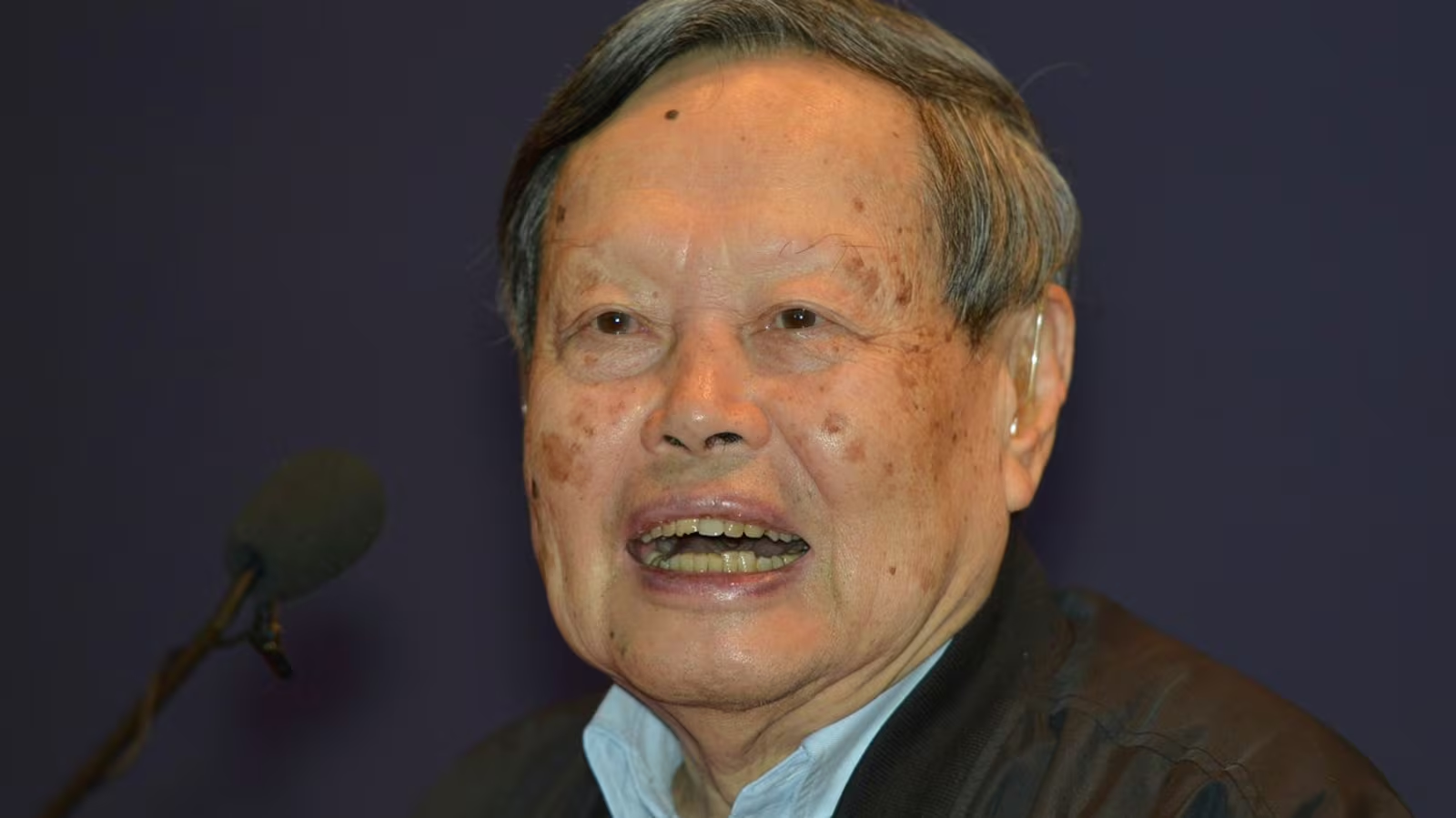
Renowned Nobel laureate Chen Ning Yang, one of the most brilliant minds in 20th-century physics, passed away in Beijing at the age of 103. Tsinghua University, where Yang both studied and later taught, confirmed his passing on Saturday, noting that he died of an illness.
Yang’s profound contributions to physics transformed scientific understanding on a global scale. “Professor Yang is one of the greatest physicists of the 20th century, having made revolutionary contributions to the development of modern physics,” Tsinghua University said in a statement that also praised his role in advancing science and education in China.
In 1957, Yang shared the Nobel Prize in Physics with Tsung-Dao Lee for their groundbreaking research on the parity laws of elementary particles — discoveries that fundamentally changed the field of particle physics. Their achievement marked the first time Chinese-born scientists received the Nobel Prize in Physics.
In his Nobel acceptance speech, Yang reflected on his dual identity as both Chinese and a citizen of modern science: “I am heavy with an awareness of the fact that I am in more than one sense a product of both the Chinese and Western cultures, in harmony and in conflict,” he said, expressing pride in his Chinese roots and his devotion to scientific pursuit.
Beyond his Nobel-winning work, Yang also co-developed the Yang–Mills theory with American physicist Robert Mills — a cornerstone of modern theoretical physics that continues to influence quantum field theory today.
Born in 1922 on the Tsinghua University campus where his father taught mathematics, Yang’s life was steeped in academia from the start. After earning his master’s degree from Tsinghua, he pursued his PhD at the University of Chicago under the mentorship of Nobel laureate Enrico Fermi. Later, Yang joined the Institute for Advanced Study in Princeton as a professor, where he continued his pioneering research.
Yang’s legacy extended beyond the laboratory. In 1986, he became a distinguished Professor-at-large at the Chinese University of Hong Kong, where he donated many of his awards and manuscripts, including his Nobel medal. From 1999 onward, he served as a professor at Tsinghua University, inspiring generations of Chinese scientists.
A dual citizen for part of his life, Yang became an American citizen in the mid-20th century but renounced it in 2015, calling it a “painful decision” years earlier, as his father had disapproved of his earlier naturalization. “America gave me great opportunities to study science,” he later said.
Chen Ning Yang is survived by his three children. His brilliance, humility, and lifelong devotion to science have left an indelible mark on both East and West — a bridge between worlds, much like the theories he created that continue to shape our understanding of the universe.