

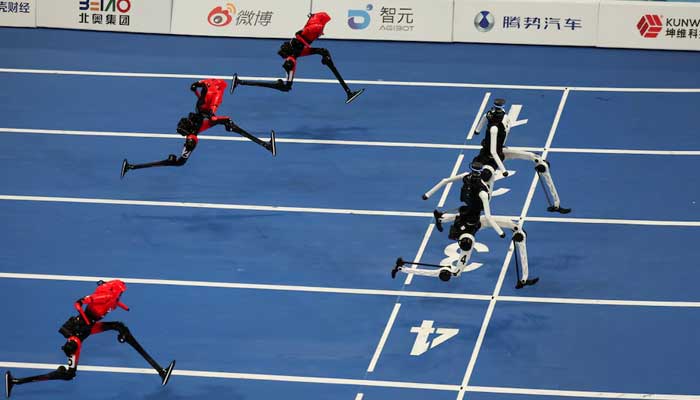
A Chinese humanoid robot has achieved a remarkable milestone in robotics by completing a 100-metre sprint in just 8.64 seconds, nearly a full second faster than Usain Bolt’s long-standing human world record of 9.58 seconds.
The Tiangong Ultra humanoid recorded the time during the 2026 World Humanoid Robot Games at Beijing’s National Speed Skating Oval, demonstrating how rapidly advances in robotics are beginning to push machines beyond some limits of human physical performance.
The robot averaged almost 42 kilometres per hour during the race. Bolt set his world record at the 2009 World Athletics Championships in Berlin, a performance that remains the fastest officially recorded 100-metre sprint by a human.
Sports scientists say the comparison, however, is not as simple as putting the robot and Bolt side by side. Tiangong Ultra does not run exactly like a person, and its mechanical design provides advantages that humans cannot replicate.
One of the most noticeable differences comes at the start.
Bolt exploded from the starting blocks in his record-setting race with a reaction time of just 0.146 seconds. Tiangong Ultra begins from an upright position without conventional starting blocks and, during an earlier record attempt, appeared to take nearly a second to respond to the starting signal.
Experts believe the robot could become considerably faster if engineers improve its starting technique.
Once Tiangong gets moving, however, its mechanical advantages become increasingly apparent.
Its developers redesigned parts of the torso and waist to reduce weight and decrease the energy required to move the robot while running. Improvements were also made to its electric motors, range of movement and control software.
Instead of attempting to perfectly imitate the long strides of an elite human sprinter, Tiangong uses shorter and significantly faster steps.
Bolt completed his famous 100-metre world-record run in approximately 41 steps. Tiangong appeared to require more than 50 steps during an earlier record-breaking run, but its rapid cadence allowed it to build and maintain exceptional speed.
Robotics experts say the running style reflects the capabilities of the machine’s motors rather than an attempt to reproduce human biomechanics. Shorter strides may also help humanoid robots maintain their balance because increasing stride length too aggressively can make them unstable.
Another major difference is fatigue.
Human sprinters generate explosive power through muscles and tendons working across the ankles, knees and hips. Even the world’s greatest athletes experience neuromuscular fatigue during an all-out sprint and can begin losing speed over the final portion of a 100-metre race.
A robot powered by electric motors does not face the same metabolic limitations.
Tiangong appeared capable of maintaining its highest speed through the closing stages of its run instead of experiencing the physical slowdown that affects human athletes.
But the extraordinary performance also demonstrated one of the major challenges still facing humanoid robotics: knowing when and how to stop.
After maintaining its speed through the finish during an earlier record run, Tiangong crashed into a padded wall.
Experts say that illustrates why raw speed alone does not necessarily mean robots have surpassed humans in overall athletic capability.
A human sprinter can rapidly interpret the surrounding environment, adjust balance, change direction, slow down and make split-second decisions. Humanoid robots still have considerable room for improvement in perception, independent decision-making, turning and controlled deceleration.
Researchers therefore believe future breakthroughs may be measured not simply by whether a robot can run faster, but by whether it can combine extreme speed with human-like awareness and control.
Tiangong Ultra’s 8.64-second sprint nevertheless represents an important technological achievement. It demonstrates that humanoid robots are reaching speeds once considered exclusively within the realm of elite human athletics.
For now, Bolt’s 9.58-second mark remains the human 100-metre world record. But when humans and machines are compared purely by the stopwatch, robots have entered an entirely different race.