

Rewritten Story:
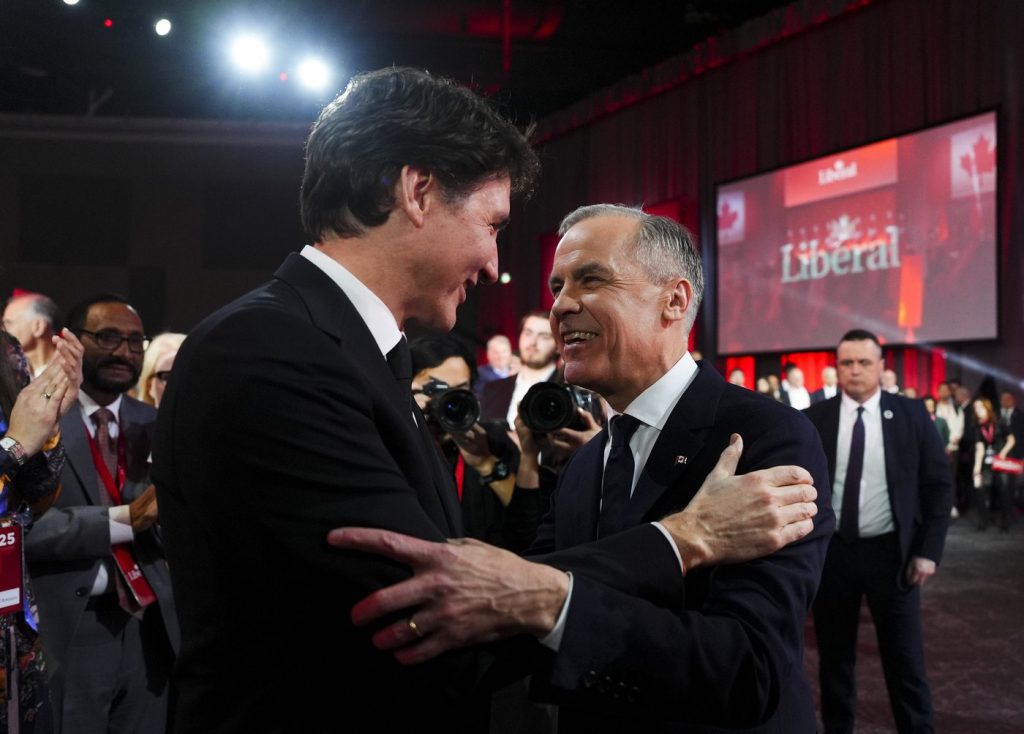
Canada began the year with Justin Trudeau as prime minister — an emotional, highly visible leader whose tearful resignation in early January set off a turbulent period in federal politics. By year’s end, the country was being led by Mark Carney, a prime minister whose reserved, disciplined style marks a clear departure from his predecessor.
In many respects, the contrast between the two Liberal leaders is striking. Trudeau was known for expressive gestures, symbolic moments and a highly performative public persona. Carney, by contrast, projects a more restrained, businesslike image, both in how he communicates with Canadians and in how he engages with international counterparts.
While both men share a political legacy of reviving the Liberal Party at moments of deep uncertainty, their public identities — and approaches to leadership — differ sharply.
“Mark Carney doesn’t wear coloured socks,” said Alex Marland, a political science professor at Acadia University who studies political branding. “That symbolism matters. Justin Trudeau was very performative. One of the challenges was that things would be said but not always actioned.”
When Trudeau first came to power, his government brought a sense of novelty and optimism. He became known as a celebrity prime minister, taking selfies with supporters and appearing on the cover of Rolling Stone. Carney’s image, Marland said, is carefully controlled and markedly more formal.
“The image of Mark Carney is exactly delivered — top-down, banker, focused, driven,” Marland said. “So much of the Carney brand and messaging since the election is actually quite similar to Stephen Harper.”
Gone are the viral moments that defined Trudeau’s early years — yoga poses, shirtless jogging photos and unusual diplomatic interactions such as the much-mocked “triple handshake.” Carney instead appears in public almost exclusively in dark, tailored suits and maintains a lower media profile. He gives few interviews to Canadian outlets and has even publicly discouraged cabinet ministers from engaging reporters in informal scrums.
Carney has also developed a reputation for discipline and punctuality. Ministers who served under Trudeau are said to hurry to weekly cabinet meetings, wary of arriving late. In Ottawa political circles, stories circulate about Carney’s attention to detail and high expectations for ministers’ conduct and appearance.
That reputation follows him from his tenure as governor of the Bank of England, where British media once reported on staff being “tasered” — figuratively — in meetings for failing to meet his standards.
While Conservative critics argue Carney represents continuity rather than change — portraying him as a more restrained version of Trudeau — those who worked closely with both leaders point to meaningful differences.
Carlene Variyan, a former chief of staff in the Trudeau government, noted that Trudeau grew up immersed in politics and media scrutiny, while Carney entered public life as an outsider, openly stating he was not a career politician.
Both leaders rose to power on promises of change. Trudeau’s early messaging centred on “real change,” while Carney’s post-election language has emphasized “Canada’s new government,” a phrase once associated with Stephen Harper’s Conservatives.
“The role has shifted from someone deeply embedded in party politics to someone who is brand new to it,” Variyan said.
She added that Carney’s press conferences feel less scripted. “He doesn’t always talk like a trained politician,” she said. “He’ll make off-the-cuff remarks that give a clearer sense of what he actually thinks.”
That lack of polish has also resulted in minor missteps. Carney has occasionally mispronounced names or locations and appeared awkward at staged public events. At a Liberal holiday party last week, he enthusiastically introduced newly elected Liberal MP Michael Ma, a former Conservative, but briefly struggled to recall the name of Ma’s riding, mistakenly calling it “Union-Markhamville” instead of “Markham–Unionville.”
Marland said this imperfect presentation may resonate with voters after years of Trudeau’s carefully curated image.
“There’s a desire, especially coming out of Trudeau, for someone who doesn’t feel like a typical politician,” he said.
Regan Watts, a former adviser to the late finance minister Jim Flaherty who has worked with Carney, described the prime minister as consistent in both public and private.
“He’s exactly who you think he is,” Watts said. “Very smart, irreverent, funny, generous and warm. His expectations are high, but he holds himself to the same standard.”
Carney has also taken a different approach to party ideology. His strong focus on economic management during a period of widespread financial anxiety has allowed the Liberals to reposition themselves closer to the centre-right. A recent memorandum of understanding with Alberta to build a new oil pipeline to the West Coast marked a significant shift from Trudeau-era policy.
“I don’t think anyone had that on their bingo card for 2025,” said Jonathan Kalles, who previously worked in Trudeau’s Prime Minister’s Office. “But he decided to do it — and then he did it.”
Kalles said Carney’s PMO is widely perceived as more formal and corporate, less driven by short-term political considerations than under Trudeau — though he added that reality likely lies somewhere in between.
The ideological contrast extends to social policy. Trudeau emphasized feminism and promoted Canada’s feminist foreign policy. Carney has distanced himself from that framework, stating that Canada does not have an explicitly feminist foreign policy and surrounding himself with a leadership circle that appears more male-dominated.
On foreign relations, Trudeau’s tenure was marked by a notoriously strained relationship with U.S. President Donald Trump. While Trump has publicly struck a more positive tone toward Carney, former Trudeau adviser Brian Clow cautioned against reading too much into personal chemistry.
“The personal relationship between leaders is often overstated,” said Clow, who advised Trudeau on Canada–U.S. trade. “Trump was frustrated with Trudeau because Canada pushed back hard.”
Clow noted that Trump continues to criticize Canada’s negotiating stance, even as he speaks more favourably about Carney.
“Some people hear Trump say nice things about Carney and think it’s a totally different relationship,” Clow said. “But he’s still frustrated that Canada is standing up for itself.”
Ultimately, Clow said, personal rapport matters less than broader economic and geopolitical realities — and relationships tend to evolve as conflicts emerge over time.
“Things started positively with China and India under Trudeau as well,” he said. “But as years pass and disputes arise, it inevitably affects relationships at the top.”
As Carney completes his first year in office, his leadership has come to symbolize a decisive shift in tone — from Trudeau’s expressive, image-driven politics to a more restrained, managerial approach that is reshaping both the Liberal brand and Canada’s political culture.