

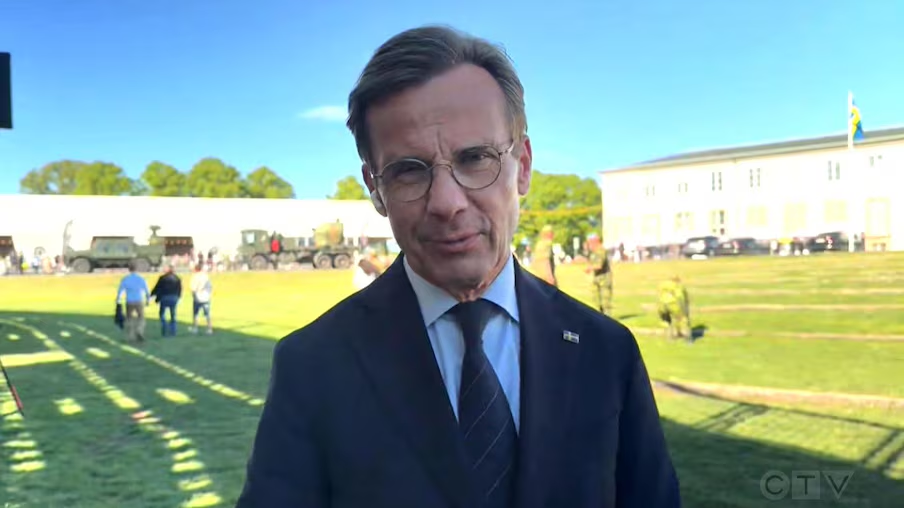
Swedish Prime Minister Ulf Kristersson has playfully suggested that Canada would fit right in with Europe’s community of nations, describing the country as “the most Nordic country in the world outside the Nordics” and joking that the European Union remains a welcoming home for like-minded partners.
Speaking during an interview with CTV’s Question Period, Kristersson was asked about recent comments from European leaders who have floated the idea of Canada joining the European Union. While acknowledging that EU membership is fundamentally tied to geography, he emphasized that shared values and common democratic principles are equally important elements of European cooperation.
With a smile, Kristersson remarked that although it was not his place to decide who joins the EU, the union remains “a very welcoming club” for countries that share similar values and outlooks. His comments echoed remarks made earlier by Alexander Stubb, who recently said Canada would fit naturally within the European family and that closer ties between Canada and Europe should continue to grow.
The friendly exchange comes at a time when relations between Canada and Sweden are strengthening, particularly in the defence and aerospace sectors. Earlier this week, Prime Minister Mark Carney announced plans to begin negotiations for the purchase of the Swedish-made GlobalEye airborne surveillance system. The proposal would involve cooperation between Swedish defence manufacturer Saab and Canadian aerospace leader Bombardier, with Canadian-built aircraft serving as the platform for the advanced surveillance technology.
Kristersson described the potential deal as a significant joint effort between Canada and Sweden, highlighting the importance of incorporating Canadian-made components and expertise. He noted that both countries share remarkably similar values and priorities and that the defence partnership represents a natural extension of an already strong relationship.
The Swedish leader said that in Sweden there is a long-standing joke that Canada is essentially an honorary Nordic country. Behind the humour, however, lies a recognition of the deep similarities between the two nations, including their commitment to democracy, social cohesion, innovation, environmental stewardship, and international cooperation.
The proposed GlobalEye purchase is also being viewed as a major economic opportunity for Canada. Canada’s Secretary of State for Defence Procurement, Stephen Fuhr, said the project aligns with Ottawa’s goal of expanding Canada’s defence manufacturing sector and increasing exports to allied countries. He suggested that Canada could potentially export completed GlobalEye aircraft to allied nations even before the Canadian Armed Forces fully integrate the system into their own operations.
Fuhr argued that the project meets several strategic objectives simultaneously by providing a needed military capability, creating jobs, strengthening domestic industry, and supporting Canadian small- and medium-sized businesses involved in the supply chain.
Not everyone is convinced. Conservative Leader Pierre Poilievre criticized the government’s defence procurement approach, arguing that increased spending must translate into better equipment for Canadian soldiers rather than additional bureaucracy and profits for large multinational contractors. While reaffirming support for stronger military investment, Poilievre said procurement reforms should focus on delivering tangible results for the armed forces.
The GlobalEye negotiations also arrive as Ottawa continues reviewing its commitment to the American-made Lockheed Martin F-35 Lightning II fighter jet program. At the same time, Canada remains open to considering Saab’s alternative proposal involving the Saab JAS 39 Gripen, keeping Sweden firmly in the conversation about the future of Canadian defence procurement.
As geopolitical tensions continue to reshape alliances and defence priorities around the world, the growing partnership between Canada and Sweden highlights how countries with shared democratic values are increasingly looking to collaborate on security, technology, and economic development. Whether or not Canada ever joins the European Union remains firmly in the realm of political humour, but the message from Stockholm was clear: Canada has many friends across Europe who see it as a natural partner in an increasingly uncertain world.