

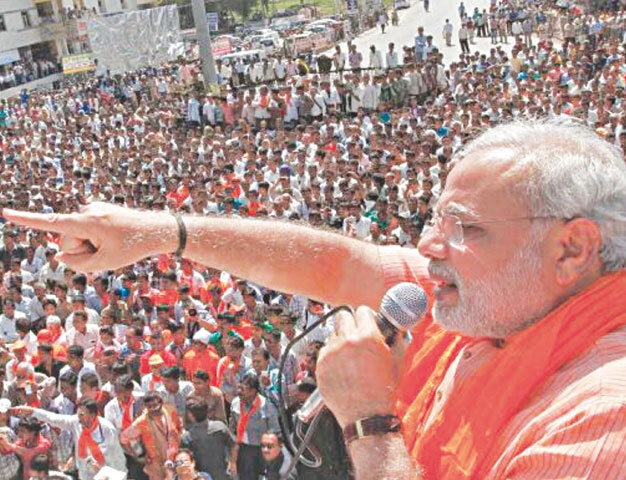
In Gujarat Under Modi: Laboratory of Today’s India, French political scientist Christophe Jaffrelot presents a detailed and critical examination of how Narendra Modi used his 13-year tenure as chief minister of Gujarat to develop and test the political, economic and social strategies that would later define his leadership of India.
Published by Liberty Publishing, the 546-page book argues that Gujarat became a “laboratory of Hindu nationalism” under Modi, who served as chief minister from 2001 to 2014 before becoming India’s prime minister. Drawing on extensive research, Jaffrelot situates Gujarat’s transformation within its distinctive geography, history and social structure, including its strong mercantile culture, entrenched caste hierarchies and long-standing Hindu-Muslim relations.
Jaffrelot, a leading scholar of South Asia, has written widely on India and Pakistan. His previous works include India’s First Dictatorship: The Emergency 1975–1977 (2020), Modi’s India: Hindu Nationalism and the Rise of Ethnic Democracy (2021), The Pakistan Paradox: Instability and Resilience (2015) and Religion, Caste and Politics in India (2010), among others.
Gujarat, India’s fifth-largest state and home to around 60 million people, has the country’s longest coastline and borders Pakistan. Muslims settled in the region soon after the arrival of Islam in the seventh century, making religious coexistence—and conflict—a central feature of its history.
At the core of Jaffrelot’s argument are what he identifies as five pillars of Modi’s political strategy. The first is communal polarisation, which, while not new in Gujarat, reached unprecedented levels during Modi’s tenure. The author points to the 2002 violence, marked by large-scale atrocities against Muslims over a two-month period, as a turning point that helped the Bharatiya Janata Party consolidate electoral support after earlier setbacks.
The second pillar, Jaffrelot writes, was the erosion of the rule of law. He argues that police officers involved in anti-Muslim violence were rewarded and that judicial accountability was weakened, contributing to broader institutional decline during Modi’s administration.
The third pillar concerns economic policy. While Gujarat has long been associated with entrepreneurship and small and medium-sized enterprises, Jaffrelot contends that Modi shifted the focus toward large-scale industrial projects. Major Indian corporations were courted, infrastructure spending expanded, and investment in social sectors such as health and education lagged behind. Business figures, including industrialist Gautam Adani, are cited as beneficiaries and supporters of this approach.
Modi’s political style forms the fourth pillar. Jaffrelot describes how Modi positioned himself as the embodiment of Gujarat in opposition to New Delhi and the Nehru-Gandhi family, using high-tech populism to communicate directly with voters. Over time, the author argues, Modi centralised power within both the state government and the party, relying heavily on bureaucratic support.
The fifth pillar involves what Jaffrelot characterises as domination over supporters, opponents and victims. The book’s later sections examine how social and political conditions enabled Modi’s rise and reshaped Gujarat’s urban and rural landscapes, often marginalising the poor while consolidating a “neo-middle class” drawn largely from lower castes and urban migrants.
The book also documents extrajudicial killings, confessions by rioters involved in attacks on Muslims, and the handling of trials following episodes of communal violence. It includes extensive crime data and 25 pages of socio-economic charts analysing trends by region, religion and class.
Jaffrelot links Gujarat’s experience to broader democratic concerns in India. He cites a 2017 survey by the Pew Research Center, which found that support for autocratic forms of governance was higher in India than in any other country surveyed, with significant public backing for rule by strong leaders or the military.
Taken together, Jaffrelot’s research builds a comprehensive case that Gujarat served as a proving ground for the policies and political methods later applied nationwide. As Modi’s prime ministership continues to shape India’s trajectory, the book argues, the legacy of his Gujarat years remains central to understanding the country’s present political landscape.