

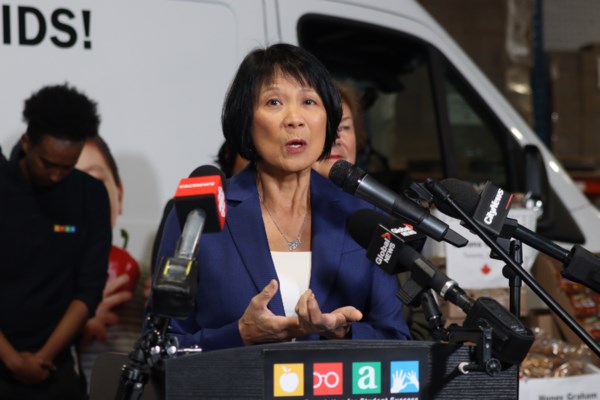
TORONTO: Toronto Mayor Olivia Chow is promising to take the city’s school food program a major step further by providing free lunches to students across Toronto if she is re-elected in the Oct. 26 municipal election. While the proposal could offer significant relief to families struggling with rising food costs, questions remain about how the ambitious program would be funded and delivered.
Chow has long advocated for universal school meals. At her campaign launch, she recalled discussing the idea with her late husband, Jack Layton, more than three decades ago, when they reflected on children whose families could not afford the kind of holiday meals enjoyed by others.
During Chow’s current term, Toronto has significantly expanded its school food program, which now provides at least a mid-morning meal or snack to approximately 330,000 students across the city. Her latest proposal would eventually add lunch, beginning with a pilot program in communities with the greatest need before expanding city-wide over four years.
Chow has not provided a final price tag for the lunch initiative, saying the cost would depend on the needs and existing facilities of individual schools, as well as financial participation from the provincial and federal governments.
According to Chow, providing both morning meals and lunches at school could save an average family about $1,800 per child annually. She argues that the program would not only reduce pressure on household budgets but also save parents time preparing lunches and ensure children have enough food and energy to learn, participate in activities and succeed at school.
Toronto has already committed more than $30 million to its school food program in the 2026 budget. The Ontario government has contributed another $8.5 million, while Ottawa has provided nearly $5 million. However, public funding still does not cover the full operating cost, leaving the program dependent in part on private donations.
Sahar Raza, vice-president of research at the Daily Bread Food Bank, has cautioned that Toronto would likely need substantially greater financial support from Queen’s Park and Ottawa before a universal lunch program could be sustainable. She noted that provincial and federal contributions currently cover only a portion of actual food costs, making it difficult for the city to carry the financial burden of both morning meals and lunches on its own.
The proposal has also become an election issue. Councillor Brad Bradford, one of Chow’s mayoral opponents, has criticized the plan for being announced without a clear estimate of its total cost or a detailed funding strategy. While Bradford has expressed support for ensuring children are properly fed, he has questioned whether Chow’s proposed expansion is financially realistic.
Cost, however, is only one challenge. Serving a snack is considerably simpler than preparing hundreds of thousands of complete lunches. Schools would require adequate kitchens or food preparation arrangements, refrigeration, storage, transportation and distribution systems.
Toronto has already begun addressing some of these infrastructure needs. Over the past two years, the city has spent nearly $8 million helping schools purchase refrigerators, freezers and other equipment needed to store and distribute food supplied through bulk purchasing programs.
Toronto’s cultural diversity adds another consideration. School meals would need to accommodate allergies, religious requirements and cultural dietary preferences. Halal meat and other specialized foods can be more expensive, meaning some schools could rely more heavily on vegetarian alternatives to provide affordable meals suitable for a broad range of students.
Despite the financial and logistical hurdles, supporters believe a universal lunch program could become an important investment in children and families, particularly at a time when grocery bills and other household expenses remain a major concern.
For Chow, the proposal represents the possible realization of an idea she has championed for decades. For Toronto taxpayers and the next city council, however, the central question will be whether the city can turn that vision into a financially sustainable program capable of serving hundreds of thousands of children every school day.