

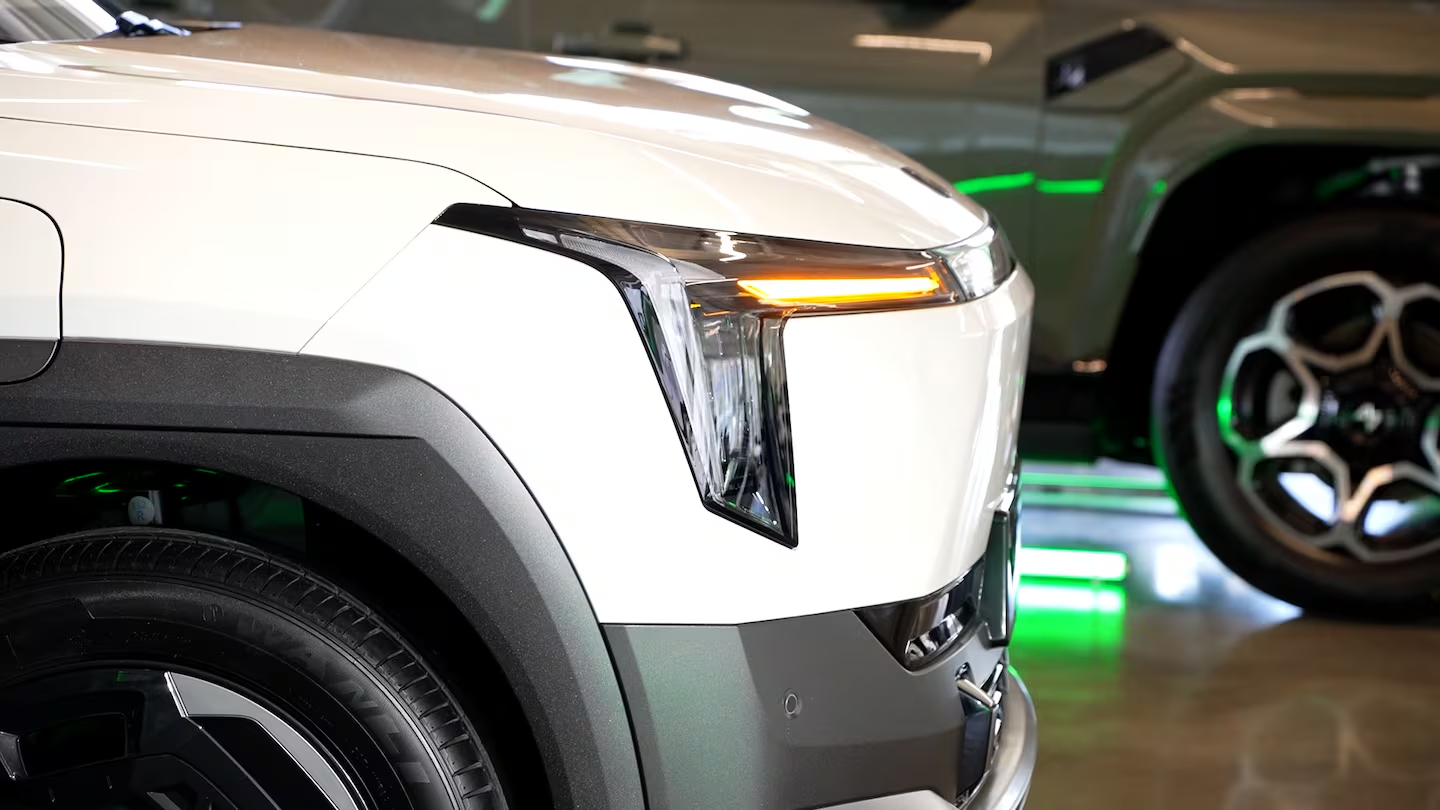
Chinese automobile manufacturer Dongfeng Motor Corporation has taken a major step toward entering the Canadian market by unveiling six of its latest electric vehicle models at an exclusive event in Montreal. The showcase, attended by hundreds of invited guests at the Port of Montreal, was designed to introduce the company’s brand to Canadian consumers and generate public interest ahead of its planned market launch in 2027.
The company is expected to introduce two affordable electric vehicles initially—the Vigo mini-SUV and the Nammi Box 01 subcompact. Both models are projected to retail for less than $35,000, making them attractive options for Canadians seeking budget-friendly electric transportation.
Julie Mazorra Fernandez, Director of North World Industry, the company selected to distribute Dongfeng vehicles in Canada, said the Montreal event was an opportunity to gather feedback from Canadian consumers. She noted that the company is working to ensure the vehicles meet Canadian expectations while maintaining affordability and quality.
Headquartered in Wuhan, Dongfeng is one of China’s largest automobile manufacturers and has been producing vehicles for more than 60 years. The company entered the electric vehicle sector two decades ago and now operates in over 100 countries worldwide, selling more than 1.2 million vehicles last year. It is currently completing the certification process required to sell its vehicles in Canada.
Fabio Moretti, President of North World Industry, said Dongfeng has already earned a strong reputation across Europe, where customers have responded positively to the vehicles’ quality, technology and competitive pricing. He expressed confidence that Canadian consumers would also appreciate the brand once they experience the vehicles firsthand.
Dongfeng has previously partnered with major global manufacturers, including Nissan and Stellantis, and is now exploring opportunities to establish manufacturing operations in Canada. Quebec is being considered as a potential location due to its leadership in electric vehicle adoption and the absence of a domestic automobile manufacturer.
The company’s expansion plans come as Canada’s electric vehicle market continues to grow rapidly. Recent figures show that sales of zero-emission vehicles have increased significantly over the past year, helped by renewed federal purchase incentives and rising gasoline prices. Government efforts to improve the affordability of electric vehicles have also encouraged greater consumer interest.
Canada’s evolving trade relationship with China has further opened the door for Chinese electric vehicle manufacturers. Under a recent agreement between the two countries, a limited number of Chinese-built electric vehicles can enter the Canadian market at reduced tariff rates. As a result, several Chinese manufacturers are preparing to establish a presence in Canada.
Luxury electric vehicle maker Lotus, owned by China’s Geely Group, recently began shipping its first electric vehicles to Canada, while Chinese automakers BYD and Chery are also preparing for future market entry. BYD has already obtained preliminary regulatory approval and has been testing its vehicles under Canadian driving and winter conditions.
Interest in Chinese electric vehicles is also growing among Canadian consumers. Montreal residents who recently purchased a BYD Shark plug-in hybrid in Mexico said the vehicle has attracted considerable attention whenever they drive it in Canada. They praised its performance and value, describing it as a refreshing alternative to traditional automotive brands.
Despite the growing enthusiasm, security and cybersecurity experts have continued to raise concerns about the extensive data collection capabilities of connected vehicles manufactured in China. Some experts have compared modern electric vehicles to smartphones on wheels, capable of collecting driving information, camera recordings and mobile phone data. However, some owners believe these concerns are similar to those already associated with today’s connected digital devices.
Dongfeng has emphasized that its vehicles already comply with strict privacy regulations in European markets and has committed to meeting all Canadian safety, security and privacy standards before launching its products.
Government figures indicate that thousands of Chinese-built electric vehicles have entered Canada since March, with a substantial number falling within the affordable price category targeted by Ottawa. The federal government has set a goal that by 2030, at least half of all Chinese electric vehicles imported into Canada should have a base price below $35,000.
For Dongfeng, the Montreal showcase represents only the beginning of its Canadian strategy. The company plans to continue introducing its brand to consumers, gathering public feedback and preparing for what it hopes will be a successful launch into Canada’s increasingly competitive electric vehicle market.