

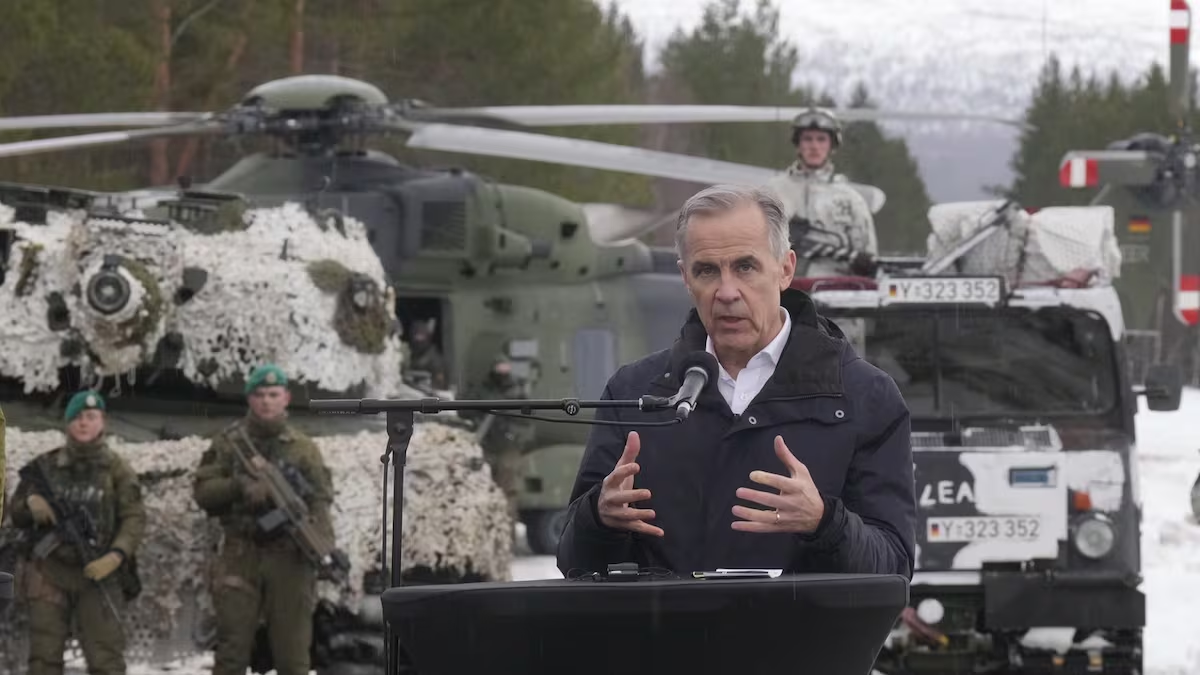
Prime Minister Mark Carney will travel to Ankara, Turkey, on Monday to attend the 2026 NATO Summit, marking the first visit by a Canadian prime minister to Turkey in more than a decade. The summit, taking place on July 7 and 8, comes at a critical time for the military alliance as member nations confront growing global security threats, increasing defence spending commitments and the challenge of maintaining unity under the leadership of U.S. President Donald Trump.
Following his visit to Turkey, Carney will continue to Saudi Arabia, where he is expected to hold discussions aimed at strengthening Canada’s trade, investment and economic partnerships in the Middle East.
Unlike previous NATO gatherings, this year’s summit has been deliberately shortened to minimize the possibility of diplomatic tensions. The traditional two-day schedule has been reduced to a leaders’ dinner and a single formal working session involving all NATO member states. Diplomats believe the streamlined format is designed to keep the focus on key security priorities while avoiding unnecessary controversy.
Former Canadian Ambassador to NATO Kerry Buck noted that one of the alliance’s principal objectives this year is to preserve unity and ensure continued American commitment to NATO. She observed that President Donald Trump’s unpredictable approach to international diplomacy has prompted allies to carefully manage discussions and avoid public disagreements. Hosting the summit in Turkey, she suggested, may help maintain a constructive atmosphere because of Trump’s relatively positive relationship with Turkish President Recep Tayyip Erdogan.
One of the summit’s central issues will be NATO’s proposal that all member countries increase defence spending to five per cent of their Gross Domestic Product by 2035. NATO Secretary-General Mark Rutte has urged every nation to present credible plans for meeting the ambitious target. Canadian officials say Prime Minister Carney will highlight Canada’s progress in strengthening its defence capabilities and will participate in discussions focused on financing future military investments.
The visit also reflects Canada’s renewed efforts to deepen its strategic relationship with Turkey, an increasingly influential NATO member situated at the crossroads of Europe, Asia and the Middle East. The Canadian government has identified four key pillars for cooperation with Turkey: defence and security, energy, trade and investment, and stronger people-to-people connections.
Turkey has emerged as an important trading partner and a rapidly growing market for Canadian businesses. Ottawa sees significant opportunities in sectors such as agriculture, mining, infrastructure, clean energy and life sciences. Turkey has also expressed interest in Canadian nuclear technology as it seeks to diversify its energy sources and reduce dependence on Russian nuclear projects.
The two countries have cooperated closely during regional crises, with Turkey assisting Canada in evacuating citizens from conflict zones across the Middle East and helping facilitate the return of Canadians detained while participating in humanitarian missions to Gaza.
Despite growing cooperation, Canada and Turkey continue to face differences on several sensitive issues. Canada officially recognizes the mass killings of Armenians during the First World War as genocide, a characterization strongly rejected by Turkey. Relations were also strained after Canada suspended exports of certain military technologies over concerns they were being used in conflicts involving Armenia and Azerbaijan. Although some restrictions have since been eased, the issue remains a point of contention.
Political differences also persist regarding human rights and democratic freedoms. Canada has granted asylum to a number of Turkish political dissidents, a move criticized by Ankara. International human rights organizations have repeatedly raised concerns over press freedom, restrictions on civil liberties and the imprisonment of journalists and political opponents in Turkey.
Security preparations for the NATO Summit have transformed Ankara into a heavily protected city, with extensive barricades and tight security measures in place to facilitate the movement of world leaders and prevent disruptions. Turkey continues to grapple with high inflation and domestic political challenges while maintaining a strategically important role in a region affected by conflicts in Ukraine, Syria and the broader Middle East.
As global tensions continue to rise, Prime Minister Carney’s visit underscores Canada’s commitment to NATO, international security and stronger partnerships with key allies. The summit is expected to shape future defence priorities while reinforcing Canada’s growing role in promoting stability, economic cooperation and collective security on the world stage.