

The United States launched military strikes against targets in Iran on Friday following a drone attack on a commercial cargo vessel in the Strait of Hormuz, significantly escalating tensions just days after Washington and Tehran reached an interim agreement aimed at ending months of conflict and restoring stability to one of the world’s most important shipping routes.
U.S. President Donald Trump said the drone attack represented a violation of the recently established ceasefire and warned that the United States would respond. Shortly afterward, U.S. Central Command confirmed that American forces had carried out precision strikes against missile launch sites, drone facilities, and coastal radar installations inside Iran. According to U.S. officials, the military operation concluded approximately one hour after it began.
Speaking before the strikes, President Trump criticized Iran’s actions, referring to the previous day’s drone attack on a cargo ship navigating through the Strait of Hormuz. Although the United States and Iran continue to hold negotiations aimed at achieving a long-term peace agreement, Trump suggested that Tehran’s actions had undermined confidence in the fragile ceasefire.
Iranian officials rejected accusations that the drone attack constituted a breach of the ceasefire, insisting that Iran continues to exercise authority over maritime security in the Strait of Hormuz. Iranian leaders maintained that recent actions were intended to manage security in the region rather than escalate military tensions.
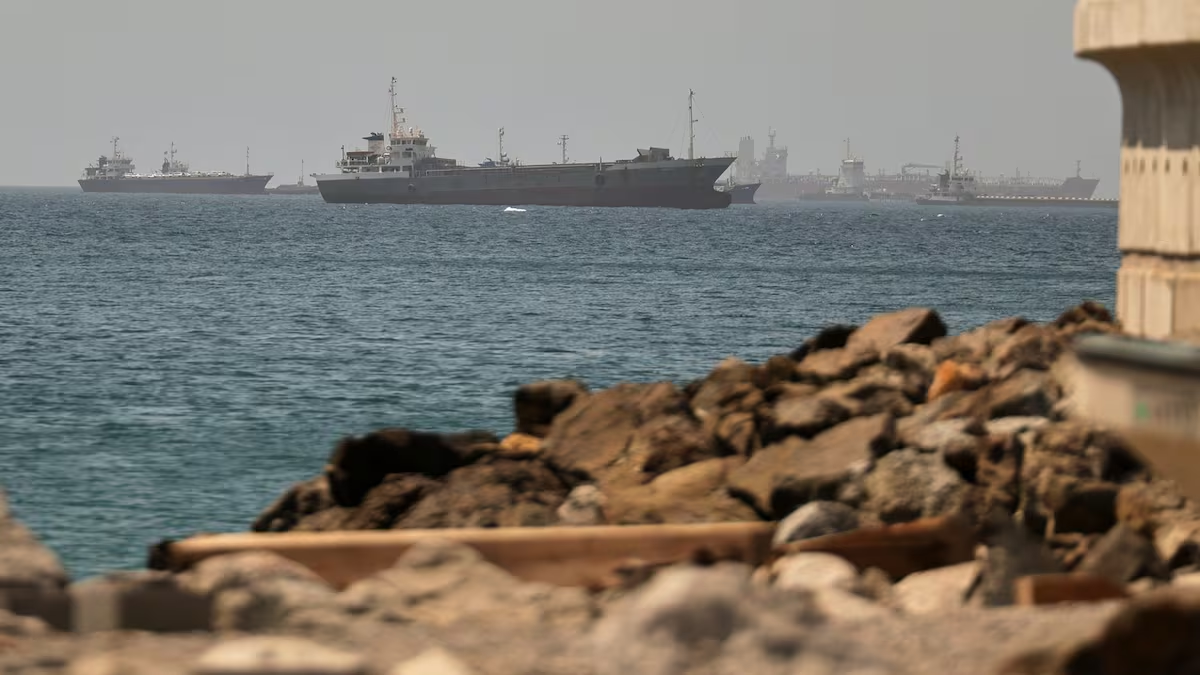
The incident occurred after a commercial container vessel was struck by a projectile off the coast of Oman, raising fresh concerns over the safety of international shipping through the strategic waterway. While no injuries were reported aboard the vessel, the attack prompted immediate concern among global maritime authorities and shipping companies.
The Strait of Hormuz remains one of the world’s most strategically important maritime corridors, carrying a substantial share of global oil and natural gas exports. The recent ceasefire between the United States and Iran had raised hopes that normal commercial shipping could gradually resume after months of disruption caused by military conflict in the region.
However, the latest attack has cast uncertainty over those expectations. The International Maritime Organization temporarily suspended its operation to escort stranded commercial vessels through an alternative shipping route near the Omani coastline after determining that additional security guarantees were required before continuing the mission. Although more than one hundred vessels have successfully departed the Gulf in recent days, hundreds of ships remain in the region awaiting safer transit conditions.
Shipping analysts say the latest escalation threatens to slow the recovery of international maritime trade through the Strait of Hormuz. While commercial traffic has continued, shipping companies are closely monitoring the security situation as insurers, vessel operators, and governments assess the growing risks associated with navigation in the area.
Despite the military exchange, negotiations between the United States and Iran remain ongoing. The two countries continue discussions on a broader agreement covering freedom of navigation through the Strait of Hormuz, regional security, and the future of Iran’s stockpile of highly enriched uranium. Under the current interim framework, both sides have a limited period to negotiate a comprehensive and lasting settlement.
Meanwhile, diplomatic developments elsewhere in the Middle East offered a measure of optimism. Israel and Lebanon announced a new framework intended to advance peace and improve security along their shared border following months of hostilities. Leaders from both countries described the agreement as an important step toward greater regional stability while acknowledging that significant challenges remain before a lasting peace can be achieved.
The latest military developments underscore the fragile nature of the current ceasefire and highlight the continuing importance of diplomacy as international leaders work to prevent further escalation in one of the world’s most strategically significant regions.