

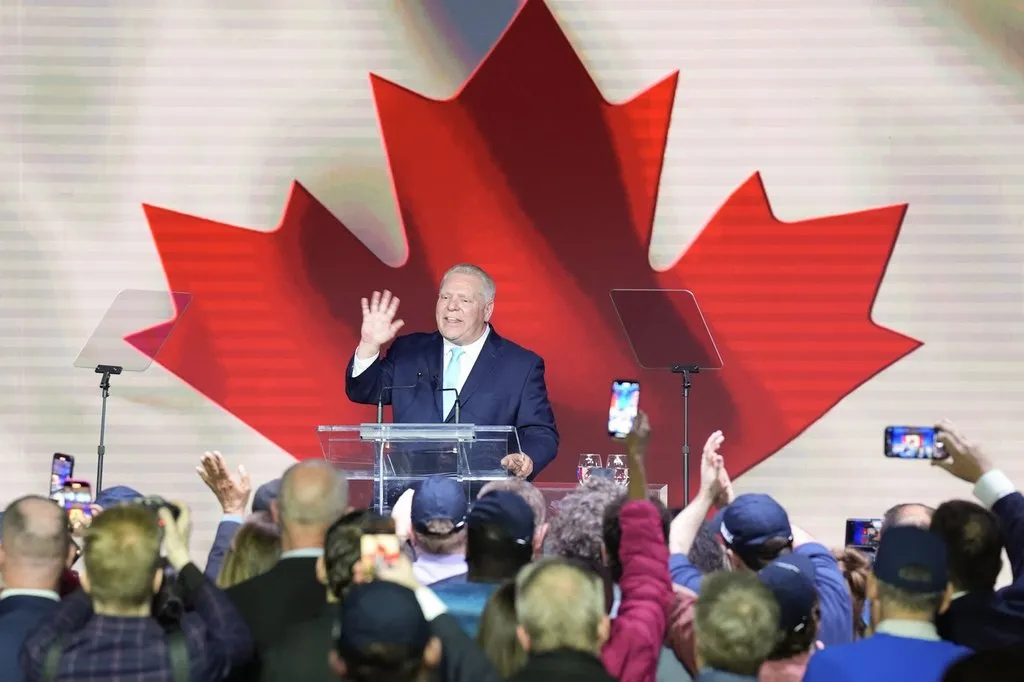
As Ontario’s Legislature prepares to reconvene following February’s snap election, Premier Doug Ford is positioning the province to take bold legislative steps to confront escalating economic tensions with the United States under President Donald Trump.
Speaking from Queen’s Park on Thursday, Ford confirmed that the Speech from the Throne—to be delivered Monday by Lt. Gov. Edith Dumont—will unveil an aggressive domestic economic agenda, framed as a direct response to Washington’s growing tariff pressure.
“Considering the position we’re in with President Donald Trump attacking us economically… it’s not business as usual,” Ford said. “We have to start moving as quickly as possible.”
At the heart of the Ford government’s plan is legislation that will designate “economic priority areas” across Ontario, particularly targeting untapped critical mineral zones like the Ring of Fire. The move is intended to speed up mine approvals and unlock the province’s strategic natural resources needed for electric vehicle battery manufacturing and global supply chains.
A second piece of legislation, expected to be introduced Wednesday, will aim to eliminate interprovincial trade barriers, allowing for the freer movement of goods and services across Canada. Ford emphasized that tearing down domestic exemptions could help counterbalance the impact of U.S. tariffs by stimulating internal trade and reducing costs for consumers.
“We’re getting rid of all exemptions right across the board,” Ford said. “I’m confident the rest of the provinces and territories will follow.”
In a show of pan-Canadian cooperation, Nova Scotia Premier Tim Houston is expected at Queen’s Park on Wednesday to sign a memorandum of understanding with Ontario, reinforcing a collective effort to streamline internal trade and economic collaboration.
Ford’s government is also preparing legislation to fast-track the construction and approval of new mines, with the aim of dramatically reducing red tape and duplication in the permitting process. Under the new plan, Ontario will adopt a “one project, one process” approach, and projects within designated “zones of economic and security interest” may receive exemptions from certain regulatory hurdles.
“It takes 15 years, as we stand right now, to get a permit. That’s unacceptable,” Ford said. “We need to move quicker and get these critical minerals out of the ground, refined, and out to the world—rather than just relying on the U.S.”
Energy and Mines Minister Stephen Lecce reinforced the economic urgency behind the move, noting that Ontario has a rare opportunity to align Canadian interests and seize international demand for responsibly sourced resources.
“This can create a significant amount of jobs for Canadians and revenue for our government,” Lecce said. “We have a rare opportunity to seize this moment of Canadian unity and economic momentum.”
As the Ford government opens the new legislative session, it is clear that economic nationalism and resource independence will dominate its priorities. Ontario is now positioning itself not only to resist the economic strain of Trump-era tariffs, but to emerge as a global hub for critical minerals and manufacturing.